
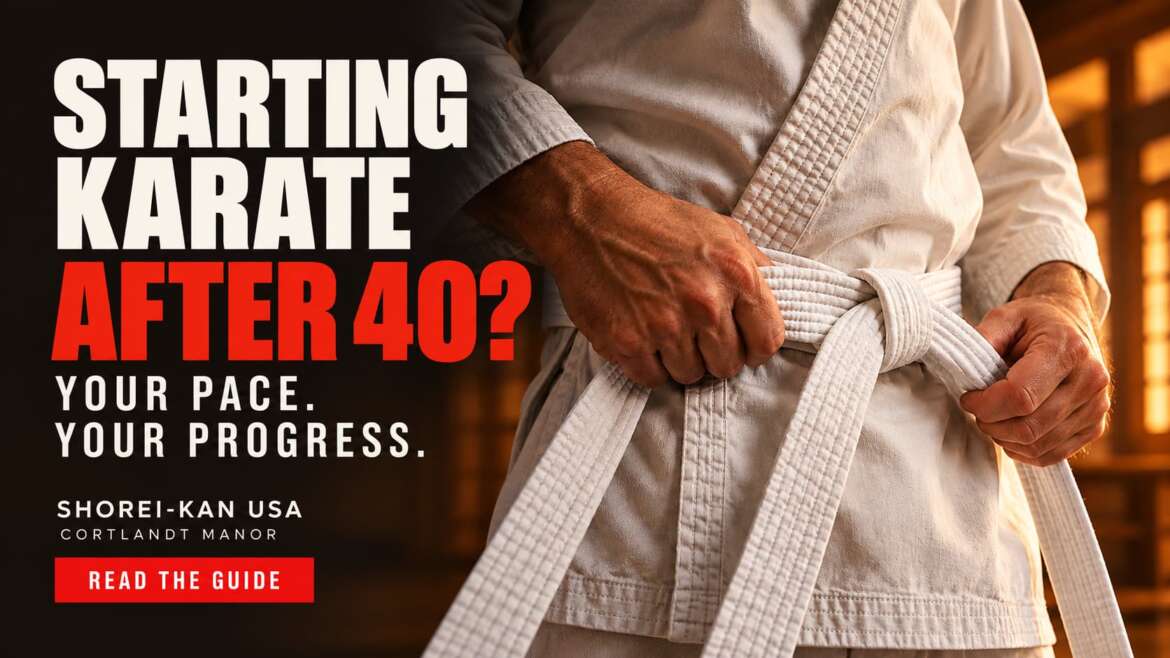
Starting karate after 40 works best when you measure yourself against your own last class, not against the student next to you. Set goals that belong to you, talk with the instructor about them, and give the training enough time to become familiar.
Many adults worry less about the first class than about what comes after it: being the beginner in a room of people who move faster, kick higher, or started years earlier. That feeling is common. It is also a poor way to judge whether karate is working for you.
Why Adults Compare Themselves in the Dojo
In most parts of adult life, you are already competent. You know your job, your routines, and your way around. A karate class puts you back at the start, learning a stance, a block, and a set of customs you have never practiced.
Some of the students around you may be younger. Some may have trained for years. Watching them can make your own progress look slow.
But the comparison does not hold up. A student who began at 15 has had years of repetition you have not had yet. A 25-year-old beginner has different circumstances, not a different standard for what counts as learning. Neither tells you anything useful about your own training.
Comparisons that mislead
- ✗ The student next to you
- ✗ Someone who began at 15 and has years of repetition
- ✗ A younger beginner with different circumstances
Comparisons that help
- ✓ You, a month ago
- ✓ The goals you set for yourself
- ✓ What the instructor tells you to work on next
What Starting Later Changes, and What It Does Not
Starting karate later in life may change your pace, how you approach certain exercises, and how much recovery you need between classes. Those are real considerations, and they are worth discussing openly with the instructor.
What may change
- Your pace
- How you approach certain exercises
- How much recovery you need between classes
What stays the same
- The foundation: stances, basic techniques, kata, and partner practice
- The order it is taught in
- The path through the Adult program, whether you start at 25, 45, or 65
What it does not change is how traditional karate is learned. Every student builds from the same foundation: stances, basic techniques, kata, and partner practice, taught in order and refined over time. In the Adult program, that path is the same whether you start at 25, 45, or 65.
Adults also bring things to training that help. Many are patient with repetition, take instruction seriously, and are clear about why they came. Those qualities matter in a system built on steady practice.
Set Goals That Belong to You
A goal gives you something to measure other than the person beside you. Before you start, or in your first few weeks, ask yourself what you want from training. For example:
Which Goals Are Yours?
- ☐ Learning a traditional martial art you have always been curious about
- ☐ Having a regular activity that keeps you moving
- ☐ Understanding the purpose behind kata and partner practice
- ☐ Working steadily toward your next rank
- ☐ Studying the history and customs of Okinawan karate
You may have more than one reason, and your reasons may change. That is fine. The point is to know what you are working toward so you can recognize progress when it happens.
Break long-term goals into near-term ones
A black belt is a long-term goal. On a given week, a more useful target is smaller: remembering the next part of a kata, holding a stance with better balance, or applying a correction the instructor gave you last class.
LONG-TERM GOAL
Black belt
THIS WEEK'S TARGET, PICK ONE
Remember the next part of a kata
Hold a stance with better balance
Apply last class's correction
Near-term goals give you something to finish. They also make it easier to see that you are moving forward, even when the long-term goal still feels far away.
Measure Your Progress Against Your Last Class
The most accurate comparison is you, a month ago. Ask yourself:
Monthly Self-Check
- ☐ Can I remember more of the sequence than I could before?
- ☐ Do I understand a correction faster than I used to?
- ☐ Is the class routine more familiar?
- ☐ Can I follow a demonstration with less hesitation?
Progress in karate is often quiet. A movement that once took all your attention becomes something you can do while listening to the next instruction. That is real progress, even if nobody else notices it.
Some adults find it helpful to write down one thing they worked on after each class. Looking back over a few weeks of notes gives you a clearer picture than your memory of one difficult evening.
A Simple After-Class Note
What I worked on
Correction to remember
Focus for next class
Talk to the Instructor About Your Goals
The instructor sees your practice from the outside and knows how the curriculum is structured. That makes the instructor the best person to help you set realistic goals.
Questions to Ask the Instructor
- What should I focus on over the next few weeks?
- Which part of what I am practicing should I work on first?
- How does advancement to the next rank work here?
- Are there exercises I should approach differently, and how?
- How often do you recommend I train, given my schedule?
You do not need to have every answer before you begin. A good instructor will help you understand where you are and what to work on next.
Adjusting Without Holding Back
Some adults hesitate to tell the instructor about an old injury, a stiff joint, or an exercise that gives them trouble. They worry it will make them stand out.
Tell the instructor anyway. Knowing about a limitation lets the instructor explain how to approach an exercise so that you can keep training. If you have a medical condition or recent injury, check with your doctor before starting any new physical activity.
Working at a pace that fits your body is not a lower standard. It is how you stay in training long enough to learn the material.
Give It More Than a Few Classes
The first few weeks of any new skill are the most awkward. You are learning terminology, customs, and movements all at once, and very little feels automatic yet.
That stage passes with repetition. Stances become familiar. The class routine stops being something you have to think about. Corrections start to make sense because you understand the movement they are correcting.
There is no fixed timeline for when training starts to feel comfortable. It depends on how often you attend, what you are learning, and how you practice. What helps most is continuing to show up, working on the goals you set, and asking the instructor when something is unclear.
If you have not taken your first class yet, read What to Expect at Your First Karate Class as an Adult for what to wear, what to ask, and how a first class usually runs.
Adult Karate at Shorei-Kan USA
Shorei-Kan USA's Adult Karate program welcomes complete beginners as well as students with previous martial arts experience. Seniors train within the regular Adult classes, so students at different stages of life study the same traditional system through instruction suited to their experience and ability.
Training follows a systematic, progressive approach to Okinawa Budo Kaisai-do. Students build a foundation through individual techniques, kata, prearranged sequences, partner practice, and practical applications before moving toward more advanced material. Classes also include Daruma Taiso, a series of exercises and stretches used in Shorei-Kan training.
The school teaches the Budo principles of courtesy, humility, patience, and defense rather than aggression, as described in its Budo philosophy and Dojo Kun. Patience and personal improvement are part of the tradition itself.
Classes at the Cortlandt Manor headquarters are led by Shihan Scott Lenzi, who began training in 1972 and holds the rank of 8th Dan in Budo Kaisai-do and 7th Dan in Okinawan Kobudo. Read more about his background on the Tradition page.
Adult classes are held at the Cortlandt Manor headquarters at 1062 Oregon Road. Check the Cortlandt Manor class schedule for current Adult class times.
Adult Karate at a Glance
Who trains
Complete beginners, students with previous experience, and seniors in the regular Adult classes
Training
Techniques, kata, prearranged sequences, partner practice, practical applications, and Daruma Taiso
Instructor
Shihan Scott Lenzi, 8th Dan Budo Kaisai-do, 7th Dan Okinawan Kobudo
Where
Cortlandt Manor headquarters, 1062 Oregon Road. See the class schedule.
New members
First month free, and a class to try before enrolling
Frequently Asked Questions
Am I too old to start karate at 40?
No. Shorei-Kan's Adult classes welcome complete beginners, and seniors train in the regular Adult classes. Talk with the instructor about your goals and any physical considerations before you begin.
Will I be the only older beginner in the class?
Class makeup varies from session to session. Shorei-Kan's Adult program includes students at different stages of life and experience levels. Call the dojo to ask about the current Adult classes.
How do I stop comparing myself to younger students?
Set personal goals, track your progress against your own earlier classes, and ask the instructor what to focus on next. Other students started at different times and train under different circumstances.
How long does it take to earn a belt as an adult beginner?
It depends on the school's requirements, how often you train, and how you progress. Ask the instructor how advancement works at Shorei-Kan USA.
What if I have an old injury or limited flexibility?
Tell the instructor before class so they can explain how to approach exercises that affect you. If you have a medical condition or recent injury, check with your doctor before starting.
Try an Adult Class in Cortlandt Manor
The best way to find out whether karate fits your goals is to train and see how the instruction works for you.
Every new member at Shorei-Kan USA gets their first month free, and you can try a class before enrolling. See the current special offers for details.
Call Shorei-Kan USA at 914-739-7804 or use the contact page to ask about the Adult class and how the dojo helps new adult students get started.
Start Where You Are
Ready to Try an Adult Class?
Complete beginners are welcome in Shorei-Kan's Adult classes, and seniors train in the regular Adult program. Contact the Cortlandt Manor dojo to ask about current class times and how to get started.
PLAN YOUR VISIT CALL 914-739-7804
1062 Oregon Road, Cortlandt Manor, NY 10567