
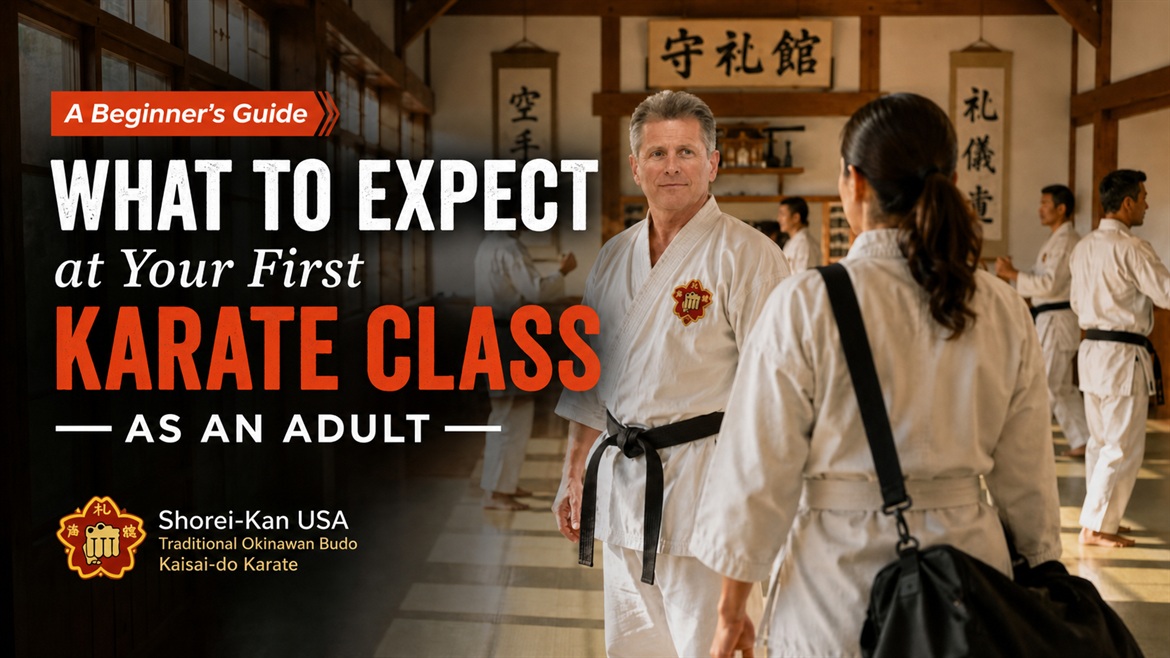
Starting karate as an adult can feel intimidating, especially when you have never stepped into a dojo before.
You may wonder whether everyone else will be more experienced, whether you are fit enough to begin, what you should wear, or whether you will be expected to spar immediately. Those questions are normal. A first class is not a test of how much you already know. It is your introduction to the instructor, the training environment, and the basic way the school teaches.
Every dojo organizes its classes differently, so you should confirm the exact details before arriving. Still, most adult beginners can expect an introduction to etiquette, foundational movements, controlled practice, and the structure of the school’s curriculum.
Here is what to know before taking your first karate class.
Your First Class at a Glance
STEP 1
Call ahead
Confirm the right class, the time, and what to wear.
STEP 2
Dress to move
Comfortable exercise clothes. No uniform needed to start at many schools.
STEP 3
Learn the basics
Etiquette, stances, and simple techniques. Awkward is normal.
STEP 4
Ask, then decide
Get your questions answered. No need to decide on the spot.
Contact the Dojo Before You Arrive
Do not assume that you can walk into any scheduled class without contacting the school first.
Adult classes may include students with different experience levels, and the instructor may want to know that a new student is coming. Calling ahead also gives you the opportunity to confirm practical details that may not be current or fully explained online.
Questions for Your Call
- Which class should an adult beginner attend?
- What day and time should you arrive?
- How early should you get there?
- What should you wear?
- Should you bring anything?
- Can you observe before participating?
- How does the introductory offer work?
- Are there any forms or requirements to complete beforehand?
Shorei-Kan USA operates its headquarters at 1062 Oregon Road in Cortlandt Manor. Call 914-739-7804 before your first visit to confirm the current adult class information and ask how the dojo introduces new students. You can also review the current Cortlandt Manor class schedule before calling.
Wear Comfortable Clothing Unless Told Otherwise
You probably will not need to purchase a karate uniform before trying your first class.
Many schools allow a new student to begin in clean, comfortable exercise clothing that permits easy movement. A T-shirt and athletic pants are common choices. Avoid clothing with zippers, hard fasteners, or anything that restricts your movement.
Karate is generally practiced barefoot, but confirm that with the dojo before you arrive. Remove jewelry, watches, and other items that could interfere with movement or partner exercises.
Bring water and a small towel if the school recommends them. Once you decide to continue, the instructor can explain the school’s uniform requirements and whether any equipment is needed.
Wear
A clean T-shirt and athletic pants that let you move freely
Bring, if recommended
Water and a small towel
Leave at home
Jewelry, watches, and clothing with zippers or hard fasteners
Karate is generally practiced barefoot. Confirm with the dojo before your first class.
Expect an Introduction to Dojo Etiquette
Traditional karate includes customs that may be unfamiliar to a new student.
You may see students bow when entering the training area, beginning class, working with a partner, or addressing the instructor. You may also hear Japanese words for techniques, positions, or commands.
You are not expected to know all of this in advance.
Pay attention, follow the instructor’s directions, and copy the class when appropriate. Ask respectfully when you do not understand something. Etiquette is learned through participation and repetition, just like the physical techniques.
At Shorei-Kan USA, etiquette reflects the school’s Budo philosophy and Dojo Kun. Its published principles emphasize courtesy, humility, patience, a peaceful spirit, personal improvement, and balanced development of spirit and technique.
The goal is not to make a beginner feel out of place. These customs help establish order, attentiveness, and mutual respect inside the dojo.
Your First Class Should Focus on Fundamentals
Do not expect to learn advanced combinations, dramatic kicks, or complex self-defense sequences during your first visit.
Traditional karate is built from foundational movements practiced repeatedly over time. Your introduction may include:
- Basic posture and stance
- Balance and foot placement
- Stepping and turning
- Simple punches or blocks
- Breathing and body control
- Introductory stretching or conditioning
- Basic etiquette and terminology
The exact lesson will depend on the instructor and what the class is studying that day.
Shorei-Kan describes its curriculum as a gradual system in which students progress from foundational movement and introductory forms toward classical Goju-Ryu kata, partner exercises, and more advanced applications. You can learn more about that progression on the Shorei-Kan USA Programs page.
You will not master the basics during one class. Your job is to listen, try the movements, and begin understanding how the instruction is organized.
You May Feel Awkward at First
Karate movements rarely feel natural on the first attempt.
You may step with the wrong foot, forget which hand moves first, turn in the wrong direction, or struggle to copy a sequence. That does not mean you are bad at karate. It means you are learning something unfamiliar.
Experienced students have repeated the same movements hundreds or thousands of times. Comparing your first class with someone else’s fifth year makes no sense.
Focus on:
- Listening carefully
- Making a reasonable effort
- Asking questions when appropriate
- Accepting corrections without embarrassment
- Learning one detail at a time
- Continuing even when a movement feels awkward
A strong instructor does not expect perfection from a beginner. The more useful question is whether the instruction helps you understand what to work on next.
You May Train Alongside More Experienced Students
Some karate schools separate beginners into introductory classes. Others place beginners in a mixed-level class and provide individual instruction or simpler versions of the lesson.
Shorei-Kan does not publish which format it currently uses, so ask before attending.
Training near experienced students is not automatically a disadvantage. Watching people with more practice can help you understand the rhythm, etiquette, and purpose of the exercises. More experienced students may also help demonstrate movements or guide a beginner through a drill.
What matters is whether you receive enough explanation and attention to participate responsibly.
You should not be left confused throughout the entire class or pressured to perform material you have not been taught. The instructor should make it clear what you are expected to attempt and what can wait until later.
Do Not Assume You Will Spar in Your First Class
Karate training can include partner exercises and forms of sparring, but schools introduce them differently.
A beginner may spend the first class entirely on movement, posture, technique, etiquette, and introductory forms. Another school may include a simple, controlled partner drill. You should not assume that you will be placed into unrestricted contact or expected to fight an experienced student.
Before participating, ask:
- When do beginners begin partner practice?
- How is physical contact introduced?
- Is participation adjusted for experience level?
- What rules govern the exercise?
- What protective equipment is used?
- Can a beginner observe an exercise before joining?
Shorei-Kan publishes information about prearranged partner practice and Shiai Kumite, a structured method that uses rules and protective equipment. That does not tell you what a new adult will do during a first class, so the instructor should explain the progression directly.
Clear answers are more valuable than broad promises that everything is completely safe.
You Do Not Need to Arrive Already in Karate Shape
You do not need previous martial arts experience to begin.
You also do not need to know the terminology, understand kata, or already be flexible. The entire point of beginner instruction is to start from your current level and learn progressively.
That does not mean the class will require no effort. You may warm up, stretch, repeat movements, hold unfamiliar stances, and use muscles differently than you normally do.
Work at a responsible pace. Tell the instructor about any limitation that affects your participation, and do not hide discomfort merely because other students are moving faster.
A beginner should be challenged to learn, not pressured to prove physical toughness during the first visit.
Pay Attention to How the Class Is Taught
Your first class is also an opportunity to evaluate the dojo.
Notice more than the techniques. Pay attention to the teaching environment.
First Class Checklist: How Is the Class Taught?
- ☐ Are instructions clear enough to follow?
- ☐ Does the instructor notice when students are struggling?
- ☐ Are corrections direct but respectful?
- ☐ Do experienced students treat beginners well?
- ☐ Does the class appear organized?
- ☐ Are partner exercises controlled?
- ☐ Can you ask reasonable questions?
- ☐ Does the instructor explain why an exercise is being practiced?
- ☐ Does the training atmosphere match what the school says online?
You do not need to understand every technique to judge whether the environment feels orderly, respectful, and serious about instruction.
A school can have impressive credentials and still be the wrong personal fit. The first class should help you decide whether you can see yourself returning consistently.
What Shorei-Kan Adult Training Includes
Shorei-Kan USA publishes an Adult karate program based on a systematic and progressive approach to Okinawan Budo Kaisai-do.
Its program description includes:
- Traditional martial arts techniques and principles
- Kata and prearranged sequences
- Practical applications
- Partner practice
- Daruma Taiso exercises and stretching
- Defensive use of technique
- Progressive development from foundational to more advanced material
The school states that seniors are welcome in its Adult classes, although prospective students should call to discuss the current class format and any individual participation questions.
Shorei-Kan also offers Okinawan Kobudo for students interested in traditional weaponry training, including solo forms and partner exercises.
Your first class will not cover the entire curriculum. It is simply the first look at how the instructor teaches and how the larger system is organized.
Questions to Ask After Your First Class
Do not leave with important questions unanswered.
Ask the Instructor
Training
- Which class should I attend regularly?
- How often should a beginner train?
- What should I practice first?
- How does belt advancement work?
- When are partner exercises introduced?
Cost and enrollment
- When would I need a uniform?
- Are there additional equipment costs?
- What are the current tuition and enrollment terms?
- What does the introductory offer include?
- Is there a minimum commitment?
- What happens after the trial period?
You do not have to make a decision immediately.
Think about whether you understood the teaching, felt comfortable asking questions, and saw a realistic path for progressing as a beginner. A clear answer to those questions matters more than whether you performed every movement correctly.
Frequently Asked Questions
Do I need a karate uniform for my first class?
That varies by school. Many dojos allow beginners to try a class in comfortable exercise clothing before purchasing a uniform. Contact Shorei-Kan USA before attending to confirm what it currently requires.
Will I have to spar during my first karate class?
Do not assume that you will. The introduction of partner drills and contact depends on the school, class, instructor, and student’s experience. Ask how Shorei-Kan introduces these parts of training before your first class.
Do I need to be physically fit before starting karate?
You do not need previous karate training or advanced physical ability to begin learning. You should still tell the instructor about limitations that may affect participation and work at a responsible pace.
Is adult karate only for younger adults?
Shorei-Kan USA states that seniors are welcomed in its Adult classes. Call the dojo to discuss the current program and determine whether the class is appropriate for your circumstances and goals.
What should I bring to the first class?
Ask the dojo when making your appointment. Comfortable exercise clothes, water, and a towel may be appropriate, but the instructor should provide the exact requirements.
Take the First Step in Cortlandt Manor
The hardest part of beginning karate is often walking into the dojo for the first time.
You do not need to know the movements, terminology, etiquette, or class routine before you arrive. You need a willingness to listen, practice, ask questions, and learn progressively.
Review Shorei-Kan USA’s Adult and Junior karate programs, then check the current introductory special offers for enrollment information.
Call Shorei-Kan USA at 914-739-7804 or use the Shorei-Kan USA contact page to ask about attending or observing an appropriate class at the Cortlandt Manor headquarters.
Ready to Try an Adult Karate Class?
Contact Shorei-Kan USA to ask about the current adult class schedule, what to wear, and how the introductory offer works at the Cortlandt Manor dojo.
CONTACT SHOREI-KAN CALL 914-739-7804
1062 Oregon Road, Cortlandt Manor, NY 10567