
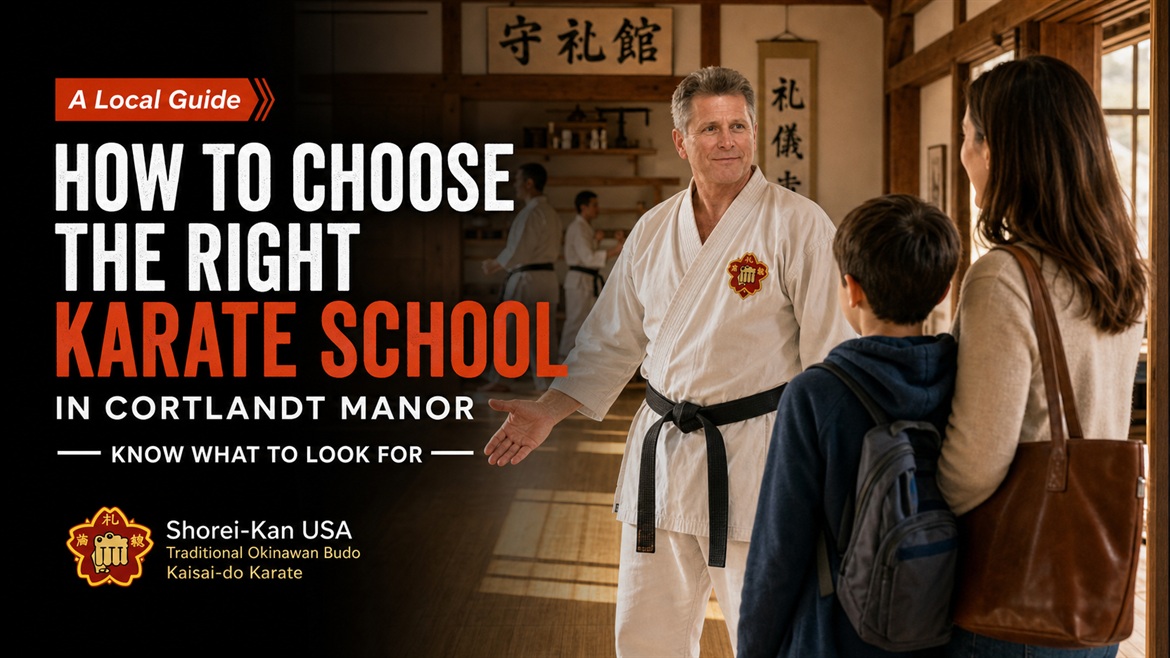
Choosing a karate or martial arts school involves more than finding the closest location or the lowest introductory price. You are choosing the instructors, teaching system, training environment, and people who may influence your experience for years.
Parents may be looking for structured instruction for a child. Adults may want physical activity, self-defense training, or a traditional practice that offers room for long-term development. Older adults may be wondering whether they can begin without previous martial arts experience.
Before committing to a school in Cortlandt Manor or elsewhere in Northern Westchester, take time to compare its teaching approach, instructor background, beginner process, programs, and training culture.
Here are the most important factors to consider.
7 Factors to Compare
1
Type of training
Traditional, competition, fitness, or self-defense focus
2
Instructor background
A clear, named training history
3
Beginner process
How new students are taught
4
Programs
Classes that fit the student's age and goals
5
Discipline and contact
Respectful correction and controlled practice
6
A visit
See a real class before you commit
7
Total cost
What follows the introductory offer
Start With the Type of Training You Want
Martial arts schools can differ considerably, even when they all use the word “karate.”
Some emphasize tournaments and competition. Others focus more heavily on fitness, kickboxing, self-defense, or traditional instruction passed through a particular system.
Before comparing schools, decide what you want from the experience.
A parent may be looking for orderly instruction and steady development for a child. An adult may want practical training, physical conditioning, or a traditional activity that can continue for years. Someone with previous martial arts experience may be looking for deeper study of kata, applications, or Okinawan weaponry.
Once your priorities are clear, it becomes easier to judge whether a school’s approach fits them.
Shorei-Kan USA teaches Shorei-Kan Okinawa Budo Kaisai-do, a traditional Okinawan system organized around gradual instruction. Students build from foundational movements and introductory forms toward classical Goju-Ryu kata, partner exercises, and more advanced applications.
For people who value traditional instruction, a defined curriculum, and steady progression rather than a primarily competition-centered approach, that distinction is worth considering.
You can learn more about the system and its philosophy on the About Shorei-Kan USA page.
Look Closely at the Instructor’s Background
An instructor’s experience affects how the martial art is taught, how the curriculum is preserved, and how students are guided through it.
Do not stop at a rank or title. Look for a clearly explained training history.
Questions About the Instructor
- Who taught the instructor?
- How long has the instructor trained and taught?
- Is the instructor connected to a named system or organization?
- Does the school explain its lineage?
- Is the instructor’s role within the organization clear?
- Does the instructor continue studying and developing?
Rank alone does not guarantee teaching quality. At the same time, vague claims about experience, unnamed teachers, or unusually high ranks with no supporting history should lead to more questions.
Shorei-Kan USA publishes a detailed training history for Shihan Scott Lenzi. According to the organization, he began training under Shihan Toshio Tamano in 1972, received his Shodan rank in 1974, and opened the Buchanan Dojo in 1980.
Shorei-Kan identifies Lenzi as the chief instructor at its Cortlandt Manor headquarters and its USA and Central America representative. The site also identifies him as an 8th Dan in Budo Kaisai-do and a 7th Dan in Okinawan Kobudo.
Shihan Scott Lenzi: Training History
| 1972 | Began training under Shihan Toshio Tamano |
| 1974 | Received his Shodan rank |
| 1980 | Opened the Buchanan Dojo |
| Today | 8th Dan in Budo Kaisai-do, 7th Dan in Okinawan Kobudo, chief instructor at Cortlandt Manor, and USA and Central America representative |
The school’s published lineage connects its instruction through Toshio Tamano, Seikichi Toguchi, Chojun Miyagi, and Kanryo Higaonna. Prospective students interested in that history can review the school’s Tradition and lineage page.
Lineage as Published by Shorei-Kan
Ask How Beginners Are Introduced to Training
How a school handles beginners tells you a great deal about its teaching quality.
A new student should not be expected to understand advanced movements, class etiquette, partner drills, or technical language immediately. Look for instruction that begins with manageable fundamentals, explains why each exercise matters, and allows students to improve without being rushed.
The early stages should have a purpose. Each movement, exercise, or form should prepare the student for what comes next.
Shorei-Kan USA describes its curriculum as a progressive system in which students build from basic movement and introductory forms toward classical Goju-Ryu kata, partner exercises, and more advanced applications.
This progression can matter to a parent enrolling a child, but it is equally important for an adult entering a dojo for the first time.
Before Choosing a School, Ask
- What does a beginner do during the first few classes?
- Are beginners separated from experienced students when appropriate?
- How are unfamiliar movements explained?
- How does the instructor respond when someone has difficulty?
- Is advancement based on demonstrated progress or simply time spent attending?
The answers should show that the school has a real teaching process rather than expecting beginners to imitate everyone else and catch up on their own.
Review the Programs and Who They Serve
A school must fit the person who will actually attend.
Children need instruction suited to their age, attention, and experience. Adult beginners may need a different pace and explanation than experienced martial artists. Older adults may want to know whether they can participate within the regular adult program.
Shorei-Kan USA publishes three principal areas of instruction:
| Program | Who it serves | What it includes |
|---|---|---|
| Junior Karate | Younger students | The fundamentals of Okinawan Budo Kaisai-do through gradual instruction |
| Adult Karate | Adults, with seniors welcomed in adult classes | Traditional techniques, kata, partner practice, practical applications, and Daruma Taiso exercises and stretches |
| Okinawan Kobudo | Students interested in traditional weaponry | Weapons such as the Bo, Tonfa, Sai, Nunchaku, and Kama, studied through solo forms and partner exercises |
The important question is not which school offers the longest program list. It is whether the available instruction matches the student’s age, interests, experience, and reasons for training.
Review the Shorei-Kan USA Programs page for more information about its Junior, Adult, and Okinawan Kobudo instruction.
Understand the School’s Approach to Discipline and Contact
Discipline in a martial arts school should be visible in the way people train, not merely advertised as a benefit.
Watch how students listen, how instructors correct mistakes, how training partners treat one another, and whether the class remains controlled as exercises become more demanding.
Courtesy, patience, attention, and restraint are stronger signs of discipline than slogans on a website.
Shorei-Kan describes its approach as Budo, which it defines as “the way to stop fighting.” The school presents martial arts as a way to train the mind and body while learning techniques intended for defense rather than aggression.
Its Dojo Kun emphasizes:
- Courtesy and humility
- A peaceful spirit
- Patience
- Personal improvement
- Balanced development of spirit and technique
- Applying these principles in daily life
Shorei-Kan also teaches partner exercises and Shiai Kumite under defined rules and with protective equipment.
A prospective student or parent should still ask how contact is introduced, when students begin partner drills, what equipment is used, and how participation differs for beginners and more experienced students.
A trustworthy answer should be specific and easy to understand. Avoid any school that dismisses reasonable questions about supervision, contact, or protective equipment.
Visit the Dojo Before Making a Decision
A website can explain a school’s programs and philosophy, but it cannot show you how the dojo feels during an actual class.
Visit before making a commitment whenever possible.
Watch For
- ☐ Whether the class appears organized
- ☐ Whether instructions are clear
- ☐ Whether students are attentive and engaged
- ☐ Whether beginners receive appropriate guidance
- ☐ How the instructor corrects mistakes
- ☐ How students treat one another
- ☐ Whether the environment feels welcoming without being careless
- ☐ Whether the teaching matches the promises made online
Ask During Your Visit
- How does a new student begin?
- Which program fits the student’s age and experience?
- How are partner drills and contact introduced?
- What clothing or equipment is required?
- What are the current class days and times?
- What costs or commitments follow the introductory offer?
- How does advancement work?
The answers should help you understand exactly what participation will involve.
Do not feel pressured to make an immediate decision. A suitable school should be willing to explain its program clearly and give you enough information to judge whether it fits your needs.
Look Beyond Distance and Introductory Price
Convenience matters. A school must be close enough and scheduled well enough for regular attendance.
Price matters too, but the least expensive option is not automatically the best value. An attractive introductory offer tells you very little about the quality of instruction, the long-term cost, or whether the school matches the student’s goals.
Cost Checklist: Before Enrolling, Understand
- ☐ What the introductory offer includes
- ☐ How long the offer lasts
- ☐ Whether a minimum enrollment period applies
- ☐ What regular tuition will be afterward
- ☐ Whether uniforms or equipment are included
- ☐ Whether testing, belt, membership, or equipment fees are separate
- ☐ What happens if the schedule does not work for you
Shorei-Kan USA publishes introductory enrollment information on its Special Offers page. Read the complete terms and contact the school directly to confirm that the offer is current and understand what follows it.
A good decision balances convenience and cost with the quality of instruction, the program structure, and the likelihood that the student will want to continue attending.
What Shorei-Kan USA Offers in Cortlandt Manor
Shorei-Kan USA operates its USA headquarters at 1062 Oregon Road in Cortlandt Manor, New York.
The dojo teaches Shorei-Kan Okinawa Budo Kaisai-do, a traditional system connected to the Okinawan Goju-Ryu lineage of Kanryo Higaonna, Chojun Miyagi, Seikichi Toguchi, and Toshio Tamano.
Shorei-Kan identifies Shihan Scott Lenzi as the chief instructor at the Cortlandt Manor dojo and its USA and Central America representative.
For people comparing karate and martial arts schools in Northern Westchester, Shorei-Kan offers several clear points to consider:
- Traditional Okinawan karate instruction
- A progressive curriculum for beginners and continuing students
- Junior and adult programs
- Seniors welcomed in adult classes
- Okinawan Kobudo weaponry training
- A Budo philosophy centered on courtesy, restraint, patience, and defensive use of technique
- A published instructor history and organizational lineage
These qualities will not make Shorei-Kan the right school for every person. Someone primarily interested in tournaments, competitive MMA, or fitness kickboxing may prefer a different training environment.
Shorei-Kan may fit if you want
- Traditional Okinawan instruction
- Systematic progression
- A long-term martial arts practice
Another school may fit if you want
- A tournament focus
- Competitive MMA
- Fitness kickboxing
For parents and adults seeking traditional Okinawan instruction, systematic progression, and a long-term martial arts practice, Shorei-Kan USA provides a distinct local option worth visiting.
Take the Next Step
The best way to evaluate Shorei-Kan USA is to learn more about the programs and speak directly with the Cortlandt Manor dojo.
Review the Programs page for information about Junior karate, Adult karate, seniors participating in adult classes, and Okinawan Kobudo.
You can also review the current Special Offers and use the contact page to ask about observing a class, visiting the dojo, or getting started.
Call Shorei-Kan USA at 914-739-7804 to ask which program may fit you or your child at the Cortlandt Manor headquarters.
See the Difference for Yourself
Ready to Visit Shorei-Kan USA?
A website can tell you about a karate school. A visit lets you experience the instruction, atmosphere, and people firsthand. Contact the Cortlandt Manor dojo to ask which program may fit you or your child.
PLAN YOUR VISIT CALL 914-739-7804
1062 Oregon Road, Cortlandt Manor, NY 10567