
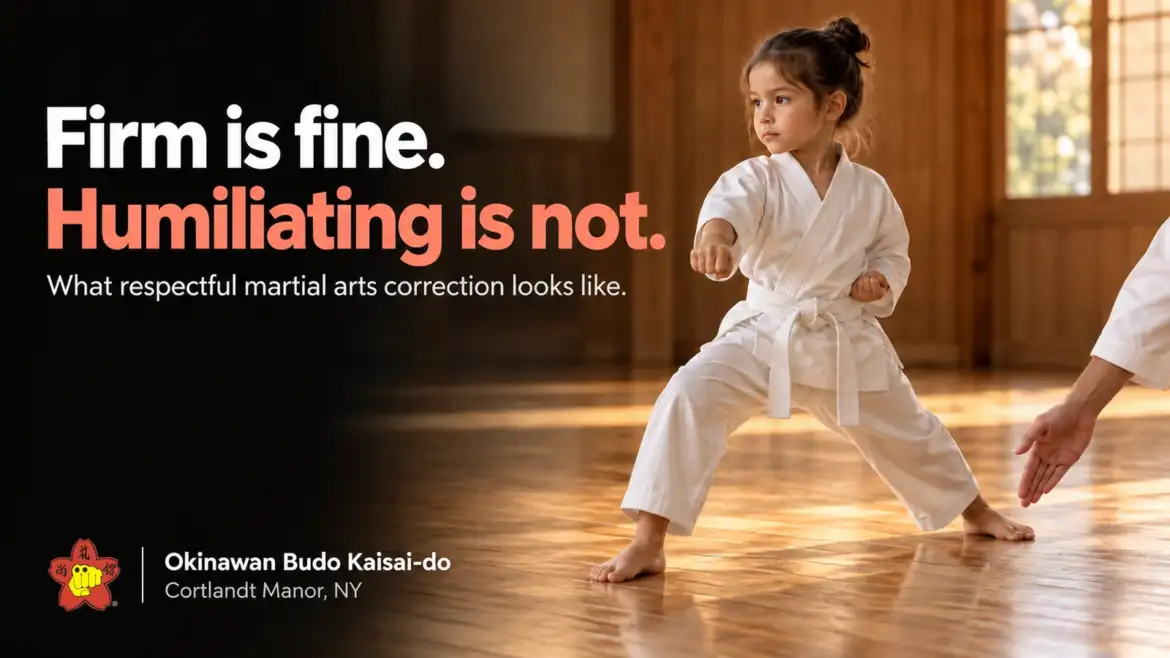
Good martial arts discipline for children is clear, consistent, and respectful. An instructor sets expectations, corrects mistakes by showing students what to change, and holds everyone to the same standard without singling a child out to embarrass them. When you watch a class, look at how mistakes are handled. That tells you more than any promise about discipline on a website.
Many parents look for martial arts classes because they want structure for their child. That is a good reason. But structure and harshness are not the same thing, and it helps to know the difference before you enroll.
What Discipline Should Look Like in a Dojo
Discipline in a traditional dojo shows up in the routine. Students bow, line up, listen when the instructor speaks, and practice with focus. Those customs give a class order, and children often respond well to knowing what is expected.
Humiliation is different. It uses embarrassment as a teaching tool. A child who is mocked, compared unfavorably with others, or corrected in a way that shows them nothing may follow the rules out of fear, but they are not learning much about martial arts.
Discipline looks like
- ✓ Clear expectations stated in advance
- ✓ The same rules for every student
- ✓ Corrections that show what to change
- ✓ A chance to try again
- ✓ Recognition of effort, not only results
Humiliation looks like
- ✗ Mocking or name-calling
- ✗ Singling a child out to embarrass them
- ✗ Comparing a child unfavorably with others
- ✗ Criticism with no instruction attached
- ✗ Punishment for not yet knowing something
A Firm Voice Is Not the Same as a Harsh One
Some parents are surprised the first time they hear an instructor call out commands in a strong voice. Traditional martial arts classes often use short, loud commands and the kiai, a sharp shout used with some techniques. Volume alone does not tell you much.
What matters is what the voice is doing. A firm command gets a class's attention and keeps practice moving. A harsh voice is aimed at a person: it belittles, ridicules, or makes an example of a child. Listen for the purpose behind the tone, not only the volume.
How Respectful Correction Works
Every student makes mistakes, and correction is how martial arts are taught. A useful correction follows a simple pattern:
1. NOTICE
The instructor sees what needs to change.
2. SHOW
They demonstrate or explain the correct version.
3. TRY AGAIN
The student gets another chance to practice.
4. ACKNOWLEDGE
The instructor notes the effort or the improvement.
A correction can be brief and direct and still be respectful. "Turn your back foot out" is clear and useful. What matters is that the child leaves the correction knowing what to do next, not just knowing they did something wrong.
What to Watch During a Class
The best way to judge how a school handles discipline is to watch a class in person. Pay attention to moments when a student struggles or makes a mistake.
Class Observation Checklist
- ☐ Expectations are clear, and students seem to know them
- ☐ Corrections include a demonstration or explanation
- ☐ A struggling student gets help rather than ridicule
- ☐ The instructor holds every student to the same rules
- ☐ Experienced students treat beginners with respect
- ☐ The instructor notices effort as well as results
- ☐ Children look focused, not fearful
One class is a snapshot. A good instructor may have a firm day, and a nervous child may look uneasy in a room that is perfectly respectful. If you are unsure, watch another class before deciding.
Questions to Ask the Instructor
Most instructors are glad to explain how they run a class. A few questions give you a clear picture:
Ask Before You Enroll
- How do you correct a student who is struggling with a technique?
- What happens when a child is not following the rules?
- Do you use consequences such as push-ups, and if so, when?
- Who else helps teach, and how are they guided?
- How can parents raise a concern?
Clear, specific answers are a good sign. So is an instructor who welcomes the questions. Be cautious if a school brushes off reasonable questions about how children are treated.
Your Role as a Parent
Parents shape how a child experiences class, too. A few habits help:
- Let the instructor teach. Coaching from the side of the room can confuse a child and contradict what the instructor just said.
- Avoid comparisons. Every student progresses at a different pace. Comparing your child with others adds pressure the instructor is trying to avoid.
- Talk about class afterward. Ask what they learned and how the instructor helped them. Listen more than you correct.
After Class, Ask Your Child
"What did the instructor help you fix today?"
"How did it feel when you got a correction?"
"Was there a part of class you did not like?"
"Do you want to go back next week?"
If Something Concerns You
If you see or hear something that bothers you, address it directly and calmly.
STEP 1
Listen to your child
Ask what happened in their own words, without leading them.
STEP 2
Talk to the instructor privately
Choose a time outside of class, and describe what you saw or heard.
STEP 3
Decide what is right for your child
A good instructor will listen. If the answer does not reassure you, it is fine to look elsewhere.
If you are ever worried about a child's safety, do not wait for a conversation with the instructor. Remove your child from the situation and contact the appropriate authorities.
For more on judging a first class with a hesitant child, read My Child Is Shy: How Can We Tell Whether a Martial Arts Class Feels Right? If you are still deciding whether to start, see Is My Child Ready for Structured Martial Arts Classes? For a broader look at comparing schools, see How to Choose a Martial Arts School in Cortlandt Manor.
The Principles Behind Training at Shorei-Kan USA
Shorei-Kan describes Okinawan Budo Kaisai-do as a Budo, which it translates as "the way to stop fighting." The school presents martial arts as a way to train the mind and body while learning technique for defense rather than aggression.
That philosophy is summarized in the school's Dojo Kun, its guiding principles:
Shorei-Kan Dojo Kun
- Always be courteous and humble
- Cultivate a peaceful spirit
- Learn to be patient
- Strive to be a better person
- Develop the spirit and techniques equally
- Apply the principles of Shorei-Kan to your daily life
Attributed to Seikichi Toguchi
The Junior program uses age-appropriate pacing and close instructor supervision. The school describes its approach as structured and nonaggressive, with an emphasis on careful practice, courtesy, patience, and the use of technique for defense. Training is supervised by Shihan Scott Lenzi, who began training in 1972 and holds the rank of 8th Dan in Budo Kaisai-do and 7th Dan in Okinawan Kobudo, along with the dojo's black belt instructors. Read more on the About page.
The best way to see how those principles work in practice is to watch a class. Check the Cortlandt Manor class schedule for current Junior times, then call to arrange a visit.
Frequently Asked Questions
Is it normal for a martial arts instructor to raise their voice?
Traditional classes often use loud commands and the kiai, so a strong voice is common. What matters is whether the voice directs the class or belittles a student. Watch how the instructor speaks to a child who makes a mistake.
Is it okay for a martial arts instructor to give push-ups as discipline?
Some schools use consequences like push-ups, and practices vary. Ask how and when they are used, and whether they are applied fairly to every student. A consequence should never be used to embarrass a child.
How can I tell if an instructor is too harsh?
Look for mocking, singling a child out, or criticism with no instruction attached. Watch whether children seem focused or fearful. If you are unsure, watch another class and talk with the instructor.
Should I talk to the instructor if something bothers me?
Yes. Choose a private time outside of class and describe what you saw. A good instructor will listen and explain. If you have concerns about a child's safety, act immediately.
What principles guide classes at Shorei-Kan USA?
Shorei-Kan teaches Okinawan Budo Kaisai-do as a Budo, with a Dojo Kun built on courtesy, humility, patience, and a peaceful spirit. Its Junior classes use age-appropriate pacing and close instructor supervision. Watch a class to see how those principles show up in teaching.
See a Junior Class in Cortlandt Manor
The clearest way to understand how a dojo handles discipline is to watch it teach. Bring the observation checklist and the questions above.
Ask about current new-student offers when you call, or see the special offers page.
Call Shorei-Kan USA at 914-739-7804 or use the contact page to ask about visiting a Junior class.
See It for Yourself
Ready to Watch a Junior Class?
See how the instructor teaches, corrects, and encourages students. Contact the Cortlandt Manor dojo to ask about visiting a Junior class.
PLAN YOUR VISIT CALL 914-739-7804
1062 Oregon Road, Cortlandt Manor, NY 10567