
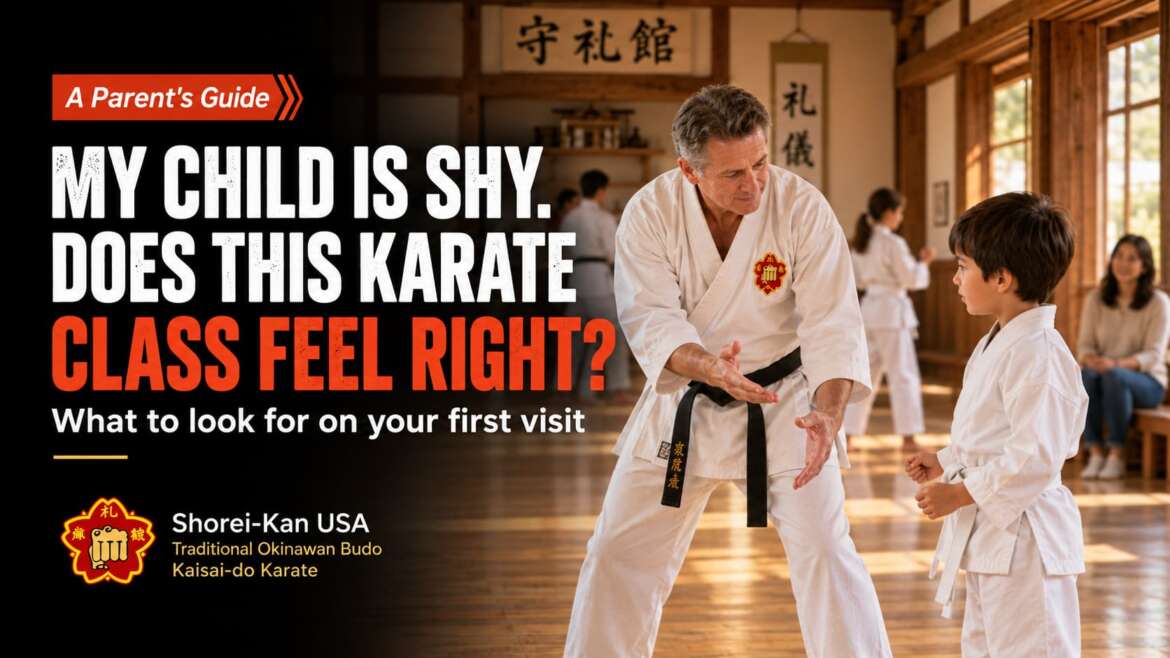
If your child is interested in karate but shy about joining a class, start with a visit and a conversation with the instructor. A welcoming teacher, clear demonstrations, and time to learn the basics can make a first class easier to approach.
The question is simple: does this class give your child a place where they can enjoy learning karate? Here is what to ask before you go and what to look for when you get there.
A Parent's Plan at a Glance
BEFORE CLASS
Ask and prepare
Find out what interests your child, call the dojo, and explain what class is like.
DURING CLASS
Watch the teaching
Notice clear demonstrations, a welcoming group, and helpful corrections.
AFTER CLASS
Ask, then listen
Ask what they liked, and give it a second or third visit if they are willing.
Start With Your Child's Interest
Some children are eager to try karate but quiet when they arrive. They may watch the other students, stay close to you, or take a little time before joining in. An unfamiliar dojo can feel like a big step.
Ask what interests your child about karate. Is it learning kicks and blocks, practicing with other children, or trying something they have seen a friend do? You do not need a detailed answer. A little curiosity is a good starting point.
If they are unsure, ask whether they would like to see a class. If they have no interest, leave room to try another activity. The first visit is a chance to find out what they think.
Talk to the Dojo Before the First Class
A phone call before the first visit to any martial arts school gives you information that is rarely on a website, and it lets the instructor know a new student is coming.
Questions for Your Call
- Which Junior class is the right starting point for my child's age?
- How are new children introduced to the class?
- Can my child watch part of a class before joining?
- Can parents stay and observe?
- How do you help a new student who is hesitant to join in?
- How long is the class, and what should my child wear?
Shorei-Kan USA does not publish a Junior age range on its website, so call to confirm which class fits your child. Schools handle observation and first visits differently, so ask rather than assume that watching first is always possible.
Pay attention to how the questions are answered. A dojo that welcomes these questions, and has thought about quiet or nervous children, is showing you something about how it teaches.
Prepare Your Child Without Overselling It
Give your child a simple picture of what a karate class is like. Tell your child, in simple terms, what to expect:
What to Tell Your Child
- ✓ There will be an instructor who shows the class what to do.
- ✓ Students may bow when they enter the training area or begin class.
- ✓ Everyone follows along and tries the movements.
- ✓ Nobody expects a new student to know anything yet.
Keep it casual. They do not need to be good at karate on the first day; they are going there to learn.
A more useful message is:
"You get to try it and see what you think. Getting a move wrong is part of learning it."
What to Watch During Your Child's First Martial Arts Class
Look for a class where beginners receive clear instruction, students treat one another respectfully, and there is plenty of time to practice.
Clear demonstrations and patient teaching
Can your child follow what the instructor is showing? A good beginner lesson breaks a movement into manageable steps and gives students a chance to try before adding more.
Notice how the instructor welcomes your child and explains unfamiliar parts of class. Bowing, lining up, and learning a new stance are all new to a beginner.
A welcoming group
Watch how students practice together. Do they give one another room? Are more experienced students respectful of beginners? Your child does not need to make a friend on the first day to enjoy being part of the class.
They may be quiet and still enjoy copying a movement or practicing alongside the others. Ask afterward which parts they liked.
Helpful corrections
Every beginner needs help with a stance, a block, or the position of their hands. A good correction shows the student what to change and gives them another chance to practice.
Listen for clear, respectful teaching. A brief demonstration or a simple reminder should help your child understand what to try next.
First Class Checklist for Parents
- ☐ My child could follow what the instructor was showing
- ☐ The instructor welcomed my child and explained unfamiliar parts of class
- ☐ Students gave one another room and treated beginners with respect
- ☐ Corrections showed what to change and gave another chance to practice
- ☐ My child seemed to enjoy copying a movement or practicing with the others, even if quiet
How an Instructor Helps Beginners Get Started
Ask how the instructor introduces new students to the class. Useful things to look for include:
01
Basics first
New students get time to practice simple movements before moving on to more complicated techniques.
02
A chance to see a drill demonstrated
The instructor shows what to do before asking students to try it.
03
An explanation of class customs
Beginners learn when to bow, how to line up, and what unfamiliar words mean.
04
Practice with the kiai
The short shout used with some techniques may feel unfamiliar at first. Ask how the instructor introduces it to beginners.
05
Encouragement during practice
The instructor notices effort and helps students keep working on a technique.
These questions are useful at any dojo. They help you understand what learning there will be like for your child.
After Class: Ask, Then Listen
On the way home, give your child a chance to tell you about the class:
Questions for the Ride Home
"What was one part you liked?"
"Was anything confusing?"
"What did the instructor show you?"
"Would you want to go back and try it again?"
If you get a shrug, leave it there for now. Your child may have more to say later.
One class is rarely enough to judge fit, especially for a child who spent part of it warming up to the room. If your child is willing, a second or third visit usually gives you a clearer picture than the first.
Why Some Parents Choose Martial Arts Over Team Sports for Shy Kids
Martial arts are not better than team sports for every child. The format is different, and for some shy kids those differences matter:
| In a karate class | On a sports team | |
|---|---|---|
| Progress | Measured against the student's own previous practice | Often tied to a roster or a scoreboard |
| The spotlight | No game-day spotlight | A child may be put on the spot to make a play in front of a crowd |
| Being part of the group | Students train in the same lines and drills, so a quiet child is part of the group without being the center of it | Players share responsibility for a team result |
| Milestones | Belt ranks give a clear, long-term path from beginner toward black belt, with smaller steps along the way that can give a child a sense of accomplishment | Varies by sport and league |
A child who enjoys fast-paced group play, or who is motivated by teammates, may be happier on a team. The right choice depends on your child, not the category of activity.
Give Your Child Time to Learn
Karate gives children something concrete to work on: learning a stance, remembering a sequence, or practicing a block with a partner. As those skills become more familiar, a beginner has accomplishments they can take pride in.
Confidence may grow with that experience, but there is no need to make it the test of whether karate is worthwhile. Your child can be quiet and still enjoy training, learn new skills, and feel proud of their progress.
How long does it take a shy child to feel comfortable?
There is no fixed number of classes. Give your child a few visits if they want to return, and ask the instructor how they are getting on with the basics. Familiar faces and a familiar class routine may make the next visit easier.
Keep coming back to simple questions: are they enjoying the practice, learning something, and interested in going again?
For a broader look at credentials, programs, class culture, and cost questions, read How to Choose a Karate School in Cortlandt Manor.
How Junior Karate Is Taught at Shorei-Kan USA
Shorei-Kan USA's Junior Karate program is a traditional martial arts program that introduces younger students to the fundamentals of Okinawa Budo Kaisai-do. Instruction begins with foundational movement and technique, then progresses gradually as students become ready for more complex material.
The school describes its Junior classes as using age-appropriate pacing and close instructor supervision. The approach is structured and nonaggressive, with an emphasis on careful practice, courtesy, patience, and the use of technique for defense. Those principles come from the school's Budo philosophy and Dojo Kun.
Classes at the Cortlandt Manor headquarters are led by Shihan Scott Lenzi, who began training in 1972 and holds the rank of 8th Dan in Budo Kaisai-do and 7th Dan in Okinawan Kobudo. Read more about his background on the Tradition page.
Junior classes are held at the Cortlandt Manor headquarters at 1062 Oregon Road. Shorei-Kan also holds a 30-minute Junior Karate class in Greenwood Lake on Tuesdays from 5:00 to 5:30 p.m. Check the Cortlandt Manor class schedule for current Junior times, then call to confirm the right class for your child.
Junior Karate at Shorei-Kan USA
| Cortlandt Manor | Headquarters, 1062 Oregon Road. See the class schedule for Junior times. |
| Greenwood Lake | Junior Karate, Tuesdays, 5:00 to 5:30 p.m. |
| Instructor | Shihan Scott Lenzi, 8th Dan Budo Kaisai-do, 7th Dan Okinawan Kobudo |
| Approach | Age-appropriate pacing, close supervision, structured and nonaggressive |
| New members | First month free, and a class to try before enrolling |
Frequently Asked Questions
Is karate a good activity for a shy child?
It can be, but it depends on the child and the class. Watch how your child responds to the instructor, the other students, and correction during a first class. That tells you more than any general claim about karate.
Can karate help my shy child feel more confident?
Learning a new technique gives a child something to feel proud of. That may help confidence grow over time. Start by looking for a class your child enjoys and an instructor who teaches beginners well.
What if my child will not join in during the first class?
Talk with the instructor before the class about how they handle this. Some children need to watch before they participate. One hesitant first visit does not mean karate is the wrong choice.
Can I watch my child's karate class?
Policies vary by school. Call Shorei-Kan USA at 914-739-7804 to ask how parents can observe and how new Junior students are introduced.
What age can children start at Shorei-Kan USA?
Call the dojo to confirm which Junior class is appropriate for your child's age.
Try a Class in Cortlandt Manor
The best way to know whether a martial arts class feels right for your child is to see it in person.
Every new member at Shorei-Kan USA gets their first month free, and you can try a class before enrolling. See the current special offers for details.
Call Shorei-Kan USA at 914-739-7804 or use the contact page to ask about the right Junior class and how the dojo introduces new students.
See the Class for Yourself
Ready to Visit With Your Child?
The best way to know whether a class feels right is to see it in person. Contact the Cortlandt Manor dojo to ask about the right Junior class and how new students are introduced.
PLAN YOUR VISIT CALL 914-739-7804
1062 Oregon Road, Cortlandt Manor, NY 10567