
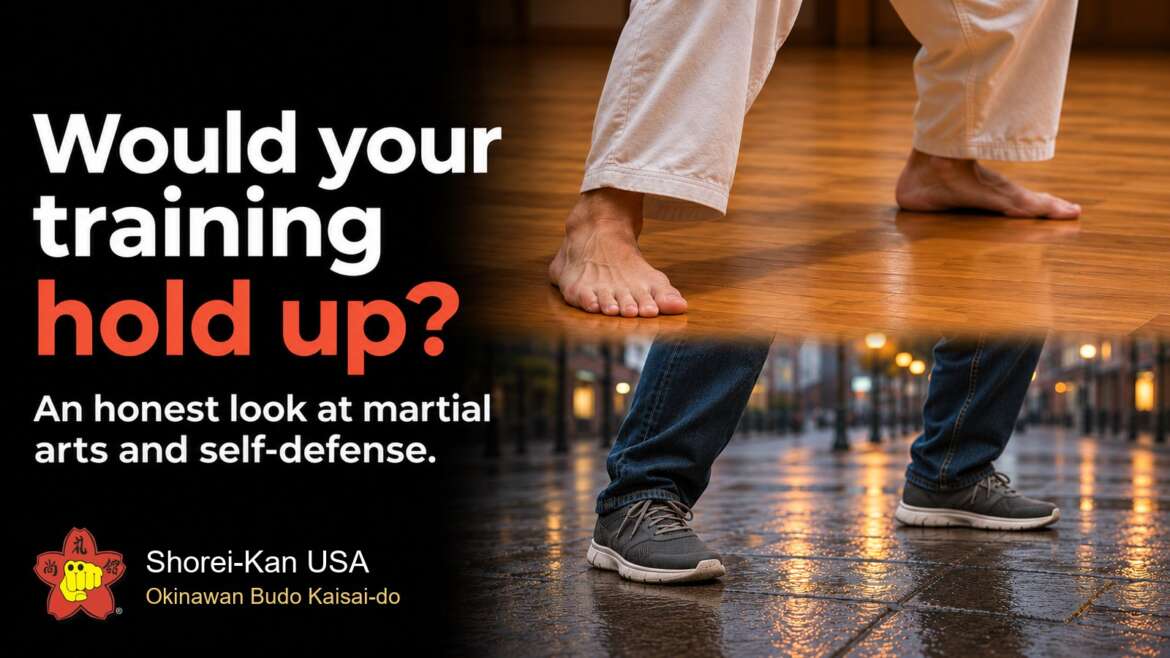
Martial arts training can tell you a lot about your self-defense skills: whether you can perform techniques with control, manage distance, react to a partner, and stay composed as pressure increases. What it cannot tell you is exactly how you will respond to a sudden, real threat, where surprise, adrenaline, and an unfamiliar setting all come into play. Your readiness depends less on the name of the art and more on how you train, how much of that training involves real pressure, and whether you also learn awareness and avoidance.
"Do martial arts work for self-defense?" is one of the most common questions people ask before starting. It deserves a straight answer, not a sales pitch. This guide explains what your training can honestly show you and what it cannot.
What Your Training Can Tell You
Regular martial arts training gives you real information about your abilities. These are signals worth paying attention to:
Technique under control
You can perform a block or strike accurately, on both sides, without thinking through each step.
Distance and timing
You can tell when a partner is in range and move before they reach you.
Composure
You stay calm and keep your technique when a partner speeds up or adds pressure.
Control of force
You can adjust your power and stop on command, which is part of real self-control.
Conditioning
Your balance, stamina, and strength are better than when you started.
Response to a partner
You react to what a partner actually does, not just to a pattern you memorized.
These are genuine skills. They are also the foundation that any self-defense ability is built on.
What Your Training Cannot Tell You
Even excellent training has limits. No class can fully recreate the conditions of a real threat.
Surprise
In class, you know when practice begins. A real threat may give no warning.
Adrenaline
Fear changes how the body and mind respond, in ways that are hard to predict.
The setting
Street clothes, uneven ground, tight spaces, and poor lighting are not the dojo floor.
Unknown factors
More than one person, an object or weapon, or an attacker with intentions you cannot read.
Your decision
Whether to leave, talk, or act is a judgment call that technique alone does not answer.
What comes after
Injuries, legal questions, and emotional effects are part of any real incident.
Being honest about these limits is not a weakness of martial arts. It is the difference between realistic confidence and false confidence. Any instructor or school that promises otherwise deserves a skeptical look.
Why Training Under Pressure Matters
Skills that look sharp in a calm class can break down under stress. That is why the way you train matters as much as what you train.
Research outside martial arts shows the point clearly. In a study of police officers published in the journal Cognitive Processing, officers who practiced a skill while under anxiety, facing an opponent who could fire back, kept their accuracy when tested under pressure. Officers who practiced only without anxiety saw their performance drop. The benefit was still present months later (Nieuwenhuys and Oudejans, 2011).
The lesson for martial arts students is not that you need to be frightened in class. It is that training should gradually add realistic pressure, so your skills have a chance to hold up when conditions change.
How Pressure Builds in Shorei-Kan Training
In Shorei-Kan, training moves step by step from solo practice to working against a partner with increasing intensity. Each step tests something different.
LOWER PRESSURE
Kata
Solo forms build technique, balance, and control. Tests whether you can perform the movement correctly.
Bunkai
Kata applications with a partner delivering a set attack. Tests whether you understand what the movement is for.
Kiso kumite
Preset two-person exercises. Tests distance, timing, and control with a moving partner.
HIGHER PRESSURE
Shiai Kumite
Full-force sparring with protective gear, specific rules, and defined striking points. Tests your technique against a partner trying to do the same.
Shorei-Kan describes Shiai Kumite, created by Master Toshio Tamano, as a way to practice full-force fighting techniques safely, and says its practice "develops strong and useful techniques." Like any sparring method, it still has rules and protective gear, which a real confrontation does not. That is exactly why the other parts of self-defense below matter. For more on how kata and partner work connect, read Why Practice Kata?
Self-Defense Is More Than Technique
Most self-defense happens before anyone throws a punch. Physical technique is the last layer, not the first.
FIRST
Awareness
Notice your surroundings and trust early warning signs.
Avoidance
Stay away from situations and places that feel wrong.
De-escalation
Calm words and body language can end a situation early.
Escape
Leaving safely is a successful outcome.
LAST RESORT
Physical defense
Only when there is no other option.
This order fits the philosophy of traditional martial arts. Shorei-Kan describes its art as a Budo, which it translates as "the way to stop fighting," and teaches technique for defense rather than aggression.
A Note on the Law
In New York, the use of physical force in self-defense is governed by Penal Law Section 35.15. In general terms, it allows physical force only to the extent a person reasonably believes it is necessary to defend against the imminent use of unlawful force, and it places stricter limits on deadly force, including a duty to retreat in many situations when it can be done with complete safety.
This is general information, not legal advice. Laws vary by state and situation.
An Honest Self-Check
If you train in martial arts and want to know where you stand, these questions give you a realistic picture:
Self-Defense Readiness Check
- ☐ I have practiced techniques with a partner, not only alone
- ☐ I have worked against a partner who adds speed or pressure
- ☐ I can keep my technique when I am tired
- ☐ I understand distance well enough to stay out of range
- ☐ I pay attention to my surroundings outside the dojo
- ☐ I think of leaving a situation as a success, not a failure
- ☐ I have asked my instructor what my training does and does not prepare me for
No one checks every box early on. Use the list to see where to focus, and talk it over with your instructor.
Questions to Ask Any School About Self-Defense
If self-defense is one of your reasons for training, ask these questions wherever you look:
Ask Before You Enroll
- How do students practice techniques against a partner?
- When and how is sparring introduced?
- Do you talk about awareness, avoidance, and de-escalation?
- What does your training not prepare students for?
- How do you teach students when not to use what they learn?
The fourth question is especially telling. A school that answers it honestly is one you can trust. Be cautious of any program that guarantees you will be able to defend yourself in any situation. If you are comparing arts, read Traditional Martial Arts or Brazilian Jiu-Jitsu: Which Kind of Class Do You Want?
Training at Shorei-Kan USA
Shorei-Kan describes Okinawan Budo Kaisai-do as being "for people who wish to learn self-defense techniques and to improve physical and mental conditions." The curriculum is systematic. Step by step, students progress from learning how to walk to learning how to slide, and from defending against a punch to defending against weapons.
The Adult program welcomes complete beginners and experienced martial artists, and seniors train in the regular Adult classes. Training includes individual techniques, kata, prearranged sequences, partner practice, and practical applications. Shiai Kumite is practiced in both the empty-hand and Kobudo classes. Learn more on the About page.
Classes at the Cortlandt Manor headquarters are led by Shihan Scott Lenzi, who began training in 1972 and holds the rank of 8th Dan in Budo Kaisai-do and 7th Dan in Okinawan Kobudo.
Shorei-Kan Training at a Glance
Philosophy
Budo, "the way to stop fighting," with technique taught for defense
Partner work
Bunkai, kiso kumite, and Shiai Kumite with protective gear and rules
Progression
From defending against a punch to defending against weapons
Where
1062 Oregon Road, Cortlandt Manor. See the class schedule.
New students
Ask about current offers when you call
Frequently Asked Questions
Are martial arts good for self-defense?
Martial arts training builds real skills that support self-defense, including technique, distance, timing, control, and composure. How useful it is depends on how you train, especially whether you practice against a partner with increasing pressure, and on whether you also learn awareness and avoidance.
How long does it take before martial arts training is useful for self-defense?
There is no fixed timeline. It depends on how often you train, the kind of partner practice involved, and your own progress. Ask your instructor what your current training does and does not prepare you for.
Does kata help with self-defense?
Kata builds technique, balance, and control, and its applications are studied with a partner through bunkai. On its own, kata does not test you against a resisting person. Its value for self-defense comes through partner work.
Is sparring necessary for self-defense training?
Practicing against a partner who adds pressure helps skills hold up under stress. Research on training under anxiety supports this. Look for a school that introduces partner work and sparring gradually and safely.
What is the most important part of self-defense?
Awareness and avoidance. Noticing danger early, staying out of bad situations, calming things down, and leaving safely prevent most confrontations before physical technique is ever needed.
Try a Class in Cortlandt Manor
The best way to judge any school's approach to self-defense is to see how it trains.
Ask about current new-student offers when you call, or see the special offers page.
Call Shorei-Kan USA at 914-739-7804 or use the contact page to ask about the Adult class and current class times.
Train Realistically
See How Shorei-Kan Trains
Watch how technique, partner work, and sparring fit together. Contact the Cortlandt Manor dojo to ask about current Adult class times.
PLAN YOUR VISIT CALL 914-739-7804
1062 Oregon Road, Cortlandt Manor, NY 10567