
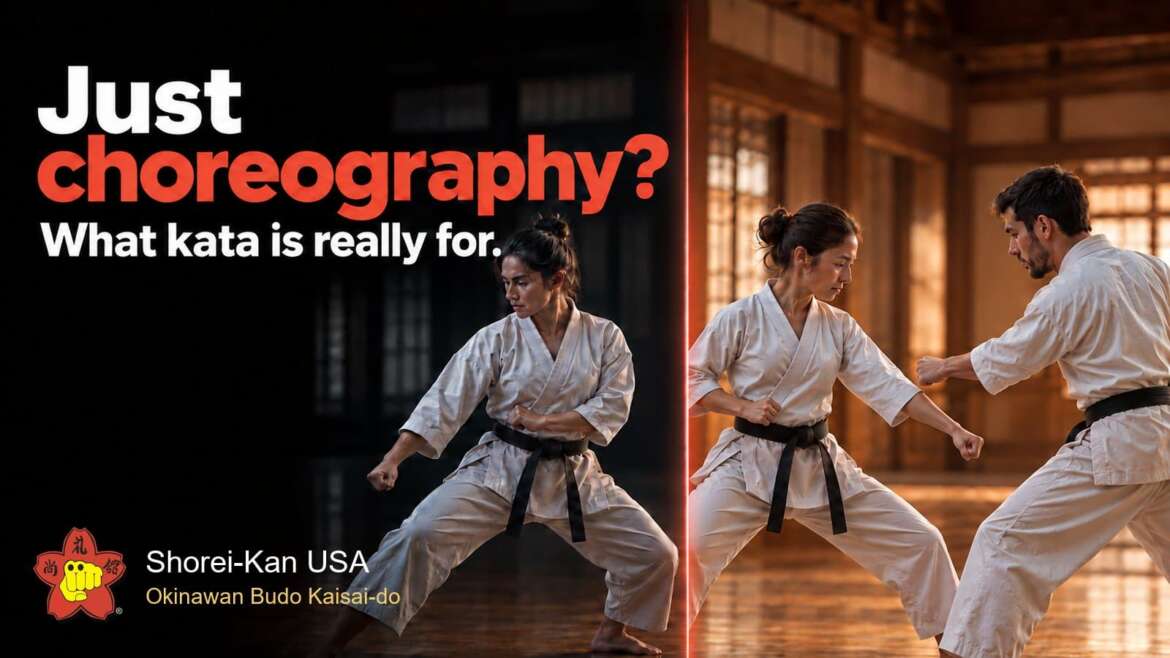
Kata is a set sequence of martial arts movements practiced alone. It trains stances, transitions, timing, and body control, and it preserves the techniques of a system in a form you can repeat for years. Kata becomes most useful when it is connected to partner work. In Shorei-Kan, students study the application of each kata, called bunkai, alongside two-person exercises, so what you practice alone is tested with a partner.
To someone watching for the first time, kata can look like a routine performed in the air. It is fair to ask what it is for. The answer depends a great deal on how a school teaches it.
What Is Kata?
A kata is a prearranged pattern of blocks, strikes, stances, and turns performed in a set order. Each movement has a purpose, and the pattern as a whole teaches how to move from one technique to the next with balance and control.
Traditional Okinawan martial arts systems pass their techniques and principles down through kata. Learning a kata means learning part of the system itself, not just a string of moves.
The Honest Question: Isn't Kata Just Choreography?
Many people who come to martial arts have heard that kata is outdated or unrealistic. That criticism has a point when kata is practiced only as a performance, with no attention to what the movements are for.
A kata on its own is not fighting. Performing a form well does not mean you can apply it against a moving partner. That gap is exactly why partner practice matters. When a school connects each kata to applications and two-person exercises, the form stops being a routine and becomes a way to study technique.
What Kata Trains
Even before you learn the applications, kata builds skills that carry into every other part of training.
Stances and balance
Holding and shifting stances builds a stable base for every technique.
Transitions
Moving from one technique to the next without losing position.
Timing and rhythm
Knowing when to move quickly, when to pause, and when to breathe.
Body mechanics
Using the whole body, not just the arm or leg, in each technique.
Focus
Keeping full attention on precise movement from start to finish.
A record of the system
Techniques and principles you can return to and study more deeply over time.
These are the reasons kata remains central in traditional schools. They also explain why it takes time. The same form can be practiced for years and still teach something new.
From Solo Form to Partner Work
The connection between kata and partner practice is where kata starts to make sense. In Shorei-Kan, students learn kata together with its applications and preset two-person exercises at each level of training.
KATA
Learn the form alone: the stances, techniques, and order.
BUNKAI
Study what the movements are for, with a partner providing the attack.
KISO KUMITE
Practice preset two-person exercises built from the same techniques.
SHIAI KUMITE
Apply techniques with full force, using protective gear and specific rules.
Each step builds on the one before it. Beginners start with kata and basic partner exercises, and more demanding practice is introduced over time under instructor direction.
Bunkai is the study of kata applications. A partner delivers a set attack, and you respond using movements from the form. A single movement may have more than one application, so bunkai also teaches you to look closely at what each part of a kata could mean.
Kiso kumite refers to preset partner exercises. Both partners know the sequence, which lets you practice distance, timing, and control safely before practice becomes less predictable.
Shiai Kumite is a sparring method created by Master Toshio Tamano. Shorei-Kan describes it as a way to practice full-force fighting techniques safely, using specially designed protective gear, specific rules, and defined striking points.
Kaisai no Genri: The Shorei-Kan View of Kata
Within the Shorei-Kan tradition, kata is not only a form to perform. It is something to study for the techniques it contains.
Kaisai signifies the work of finding hidden techniques in kata, and genri the principle behind it.
From the Shorei-Kan Tradition page
As Shorei-Kan tells it, this theory of kata was passed from Master Kanryo Higaonna to Master Chojun Miyagi, who called it Kaisai no Genri. Master Seikichi Toguchi carried the work forward, creating many new kata, including kata performed to music, along with preset sparring exercises and supplementary exercises. From these materials he built the teaching system he called Shorei-Kan karate. Master Toshio Tamano later added Shiai Kumite and several preset sparring systems. He named this evolution of Okinawan Goju-Ryu Okinawan Budo Kaisai-do.
The name itself reflects the idea at the center of this article. In Shorei-Kan, kata and the search for its applications are meant to be practiced together.
How the Shorei-Kan Curriculum Builds
Shorei-Kan was created to give students a way to make systematic progress in Goju-Ryu, which the school describes as a very sophisticated art. The curriculum moves step by step, from learning how to walk to learning how to slide, and from defending against a punch to defending against weapons.
FOUNDATION
A series of kata and two-person forms unique to Shorei-Kan, designed to build a thorough, solid knowledge of the art.
EACH LEVEL
New kata, bunkai, and kiso kumite, each a building block for the next.
ADVANCED
The complex classical Goju-Ryu forms, built on everything learned before.
This structure is why kata at Shorei-Kan is not isolated from the rest of training. The form you learn at one level comes with its applications and partner exercises, and together they prepare you for what comes next.
What This Means for a New Student
If you are new, you will not be expected to understand every movement right away. At first, most of your attention will go to remembering the order and holding your stances. That is normal.
As you progress, the partner work fills in the meaning. A block that felt abstract in the form makes sense when a partner delivers the attack it answers. Many students find that this is when kata stops feeling like memorization and starts feeling like study.
Good Questions to Ask Your Instructor
- What is this movement meant to do?
- When will I learn the bunkai for this kata?
- Which part of the form should I focus on right now?
- How does this kata connect to the partner exercises we practice?
If you are finding it hard to hold on to a new form, read I Keep Forgetting Martial Arts Movements: Does That Mean I'm Not Making Progress? If you have not taken a class yet, start with What to Expect at Your First Martial Arts Class as an Adult.
Training at Shorei-Kan USA
Shorei-Kan USA's Adult program follows a systematic and progressive approach to Okinawan Budo Kaisai-do. Students build a foundation through individual techniques, kata, prearranged sequences, partner practice, and practical applications before moving toward more advanced material under instructor direction. Complete beginners are welcome, and seniors train in the regular Adult classes.
Shiai Kumite is practiced in both the empty-hand and Kobudo classes. Okinawan Kobudo, the study of traditional Okinawan weapons, is also taught at the dojo, and prior martial arts experience is not required to begin.
Classes at the Cortlandt Manor headquarters are led by Shihan Scott Lenzi, who began training under Shihan Toshio Tamano in 1972 and holds the rank of 8th Dan in Budo Kaisai-do and 7th Dan in Okinawan Kobudo. Read more about the system on the About page and its history on the Tradition page.
Shorei-Kan Terms at a Glance
Kata
A set sequence of movements practiced alone
Bunkai
The study of kata applications with a partner
Kiso kumite
Preset two-person exercises
Shiai Kumite
Full-force sparring method with protective gear and specific rules, created by Master Toshio Tamano
Kaisai no Genri
The principle of finding hidden techniques in kata
Frequently Asked Questions
What is the point of kata in martial arts?
Kata trains stances, transitions, timing, and body control, and it preserves a system's techniques in a form you can practice for years. It becomes most useful when connected to partner work that shows what the movements are for.
What is bunkai?
Bunkai is the study of kata applications. A partner delivers a set attack, and you respond with movements from the kata. It shows how the techniques in a form can be used.
Is kata useful for self-defense?
Kata alone does not prepare you to defend yourself. Its value for application comes through bunkai and partner practice, where you work on distance, timing, and control against another person.
What is kiso kumite?
Kiso kumite refers to preset two-person exercises. Both partners know the sequence, which allows safe practice of timing, distance, and technique. In Shorei-Kan, students learn new kiso kumite at each level along with new kata and bunkai.
Does Shorei-Kan include sparring?
Yes. Shorei-Kan practices Shiai Kumite, a sparring method created by Master Toshio Tamano that uses protective gear, specific rules, and defined striking points. It is practiced in both the empty-hand and Kobudo classes. Ask the instructor how and when students are introduced to it.
Start Training in Cortlandt Manor
The best way to understand kata is to learn one and see how it connects to partner work.
Ask about current new-student offers when you call, or see the special offers page.
Call Shorei-Kan USA at 914-739-7804 or use the contact page to ask about the Adult class and current class times.
Learn It, Then Apply It
Ready to Learn Your First Kata?
At Shorei-Kan, kata is taught together with its applications and partner exercises. Contact the Cortlandt Manor dojo to ask about current Adult class times.
PLAN YOUR VISIT CALL 914-739-7804
1062 Oregon Road, Cortlandt Manor, NY 10567