
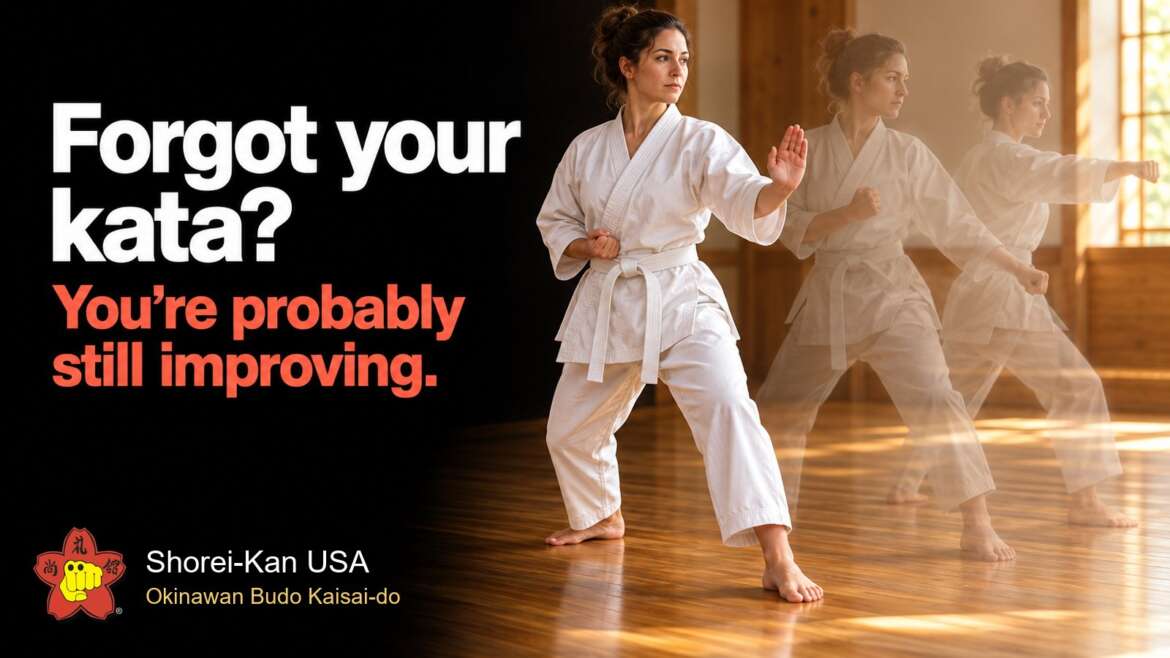
No. Forgetting martial arts movements between classes is a normal part of learning, not a sign that you are failing. Remembering a sequence and performing it well are separate skills, and both take repetition. The most useful step is to ask the instructor for one clear priority and work on that, rather than trying to hold everything at once.
Almost every beginner has the experience. A kata made sense in class, and by the next week half of it is gone. Or you remember the order but freeze when it is your turn to show it. It can feel like you are going backward. Usually, you are not.
Why Movements Are Hard to Remember
A single movement asks you to track several things at the same time. In the beginning, none of them are automatic yet.
What You Are Juggling in One Movement
Add a room full of people, an instructor watching, and unfamiliar terminology, and it is no surprise that details slip. Experienced students are usually not better at remembering in general. They have repeated the same material enough times that most of those pieces no longer need their attention.
Remembering Is Not the Same as Refining
It helps to separate two kinds of learning that happen at the same time:
Remembering the sequence
Knowing what comes next: the order of movements, the turns, and where the kata ends. This is often what beginners worry about most.
Refining the movement
Doing each movement well: balance, stance depth, timing, and control. This continues long after the order is memorized.
You can forget part of a sequence and still be improving your stances. You can remember every step and still have plenty to refine. Progress in one does not wait on the other.
How a Kata Usually Comes Together
Most students move through a similar pattern when learning a new form. Knowing where you are in it makes forgetting feel less like failure.
STAGE 1
Follow along
You copy the class and rely on watching others.
STAGE 2
Learn the order
You know most of the sequence but still pause or lose your place.
STAGE 3
Perform on your own
You can do it without watching anyone else.
STAGE 4
Refine
Your attention moves to the quality of each movement.
Students often move back a stage for a while, especially after a break or when a new form is introduced. That is normal. Each time through, the earlier stages tend to come back faster. If you are coming back after a long break, read Returning to Martial Arts After Years Away.
Signs You Are Improving, Even When You Forget
If forgetting is making you doubt your progress, look for these signs instead:
Progress Check
- ☐ A section that used to stop you now flows
- ☐ You recover faster when you lose your place
- ☐ Stances feel more stable than they did a month ago
- ☐ You understand corrections more quickly
- ☐ You need to watch other students less often
- ☐ The class routine takes less of your attention
Even one or two of these can show that your training is moving forward. Forgetting and improving often happen together.
What Helps You Remember
These habits help you hold on to what the instructor has already taught. They are not a substitute for class, and they are not a way to teach yourself new material.
01
Learn it in sections
Work on one part of a kata until it feels steady, then connect it to the next part.
02
Walk it slowly
Go through the order at a slow pace, focusing on where you go next rather than on power.
03
Name each movement
Saying the technique or direction quietly as you move gives your memory a second path.
04
Spread practice across days
A few minutes on several days usually does more than one long session.
05
Write it down after class
Note the section you worked on and the correction you received while it is fresh.
06
Keep going when you slip
In practice, pick up at the next movement you remember instead of stopping.
Research on learning physical skills generally supports spreading practice out. Studies comparing spaced and crammed practice have often found better retention when the same amount of practice is spread across days, although results vary with the task (Smith and Scarf, 2017 review).
Ask the Instructor for One Priority
When everything feels unfamiliar, trying to fix it all at once usually leads to remembering less. A better approach is to ask what matters most right now.
Questions to Ask After Class
- Which part of the kata should I focus on this week?
- Is my main issue the order or how I am doing the movements?
- What is one correction I should remember for next class?
- Is there anything I should review on my own, and how?
One clear priority gives you something to finish. It also tells you whether the instructor sees your forgetting as a concern or as a normal part of where you are.
Forgetting in Front of the Class
Losing your place while others are watching is one of the most uncomfortable moments for a new student. It happens to nearly everyone who trains long enough.
If it happens, pause, reset, and follow the instructor's direction. Instructors see beginners lose their place all the time. What stands out is not the mistake. It is whether you stay calm and keep working.
When to Talk to the Instructor
Forgetting is normal. It is still worth a conversation if:
- You feel stuck on the same section for many weeks with no change
- You are unsure what you should be practicing
- Your attendance has been irregular and you are losing the thread between classes
- The frustration is making you think about stopping
Instructors would rather hear about it early. Often a small change, such as focusing on one section or reviewing the basics that the kata is built on, makes the difference. If limited attendance is the issue, read Can I Make Progress in Martial Arts if I Can Only Attend Once a Week?
Learning Kata at Shorei-Kan USA
Shorei-Kan USA teaches Okinawan Budo Kaisai-do through a systematic, progressive curriculum. Students progress from foundational movement and introductory forms toward classical Goju-Ryu kata, prearranged sequences, partner practice, and practical applications. Each stage builds on the one before it, so the basics you practice now are part of every form you learn later.
The Adult program welcomes complete beginners as well as students with previous experience, and seniors train in the regular Adult classes. Classes also include Daruma Taiso, a series of exercises and stretches used in Shorei-Kan training.
Classes at the Cortlandt Manor headquarters are led by Shihan Scott Lenzi, who began training in 1972 and holds the rank of 8th Dan in Budo Kaisai-do and 7th Dan in Okinawan Kobudo, with the support of the dojo's black belt instructors. Read more on the Tradition page.
Adult Classes at a Glance
Curriculum
Foundational movement and introductory forms, building toward classical Goju-Ryu kata and partner practice
Who trains
Complete beginners, students with previous experience, and seniors in the regular Adult classes
Where
Cortlandt Manor headquarters, 1062 Oregon Road. See the class schedule.
New to martial arts? Start with What to Expect at Your First Martial Arts Class as an Adult. For more on measuring your own progress, read Starting Martial Arts After 40.
Frequently Asked Questions
Is it normal to forget kata between classes?
Yes. Beginners often forget parts of a kata between classes, especially early on. The sequence becomes easier to hold on to with repetition and time.
How can I remember my kata better?
Learn it in sections, walk through it slowly, name each movement as you go, and spread short reviews across several days. Stick to material the instructor has already taught you.
Does forgetting movements mean I am not good at martial arts?
No. Forgetting is part of learning any new physical skill. Look at whether your stances, recovery, and understanding of corrections are improving. Those are signs of progress.
What should I do if I forget my kata in front of the class?
Pause, reset, and follow the instructor's direction. Losing your place happens to most students at some point. Staying calm and continuing matters more than the mistake.
Should I practice martial arts at home?
A short review of what the instructor has taught can help you remember it. Ask the instructor what to review, and avoid teaching yourself new techniques.
Train in Cortlandt Manor
Learning a kata takes time, and the right instruction makes that time count.
Ask about current new-student offers when you call, or see the special offers page.
Call Shorei-Kan USA at 914-739-7804 or use the contact page to ask about the Adult class and how new students learn their first forms.
Every Form Starts Somewhere
Ready to Learn Your First Kata?
Complete beginners are welcome in Shorei-Kan's Adult classes. Contact the Cortlandt Manor dojo to ask about current class times and how new students get started.
PLAN YOUR VISIT CALL 914-739-7804
1062 Oregon Road, Cortlandt Manor, NY 10567