
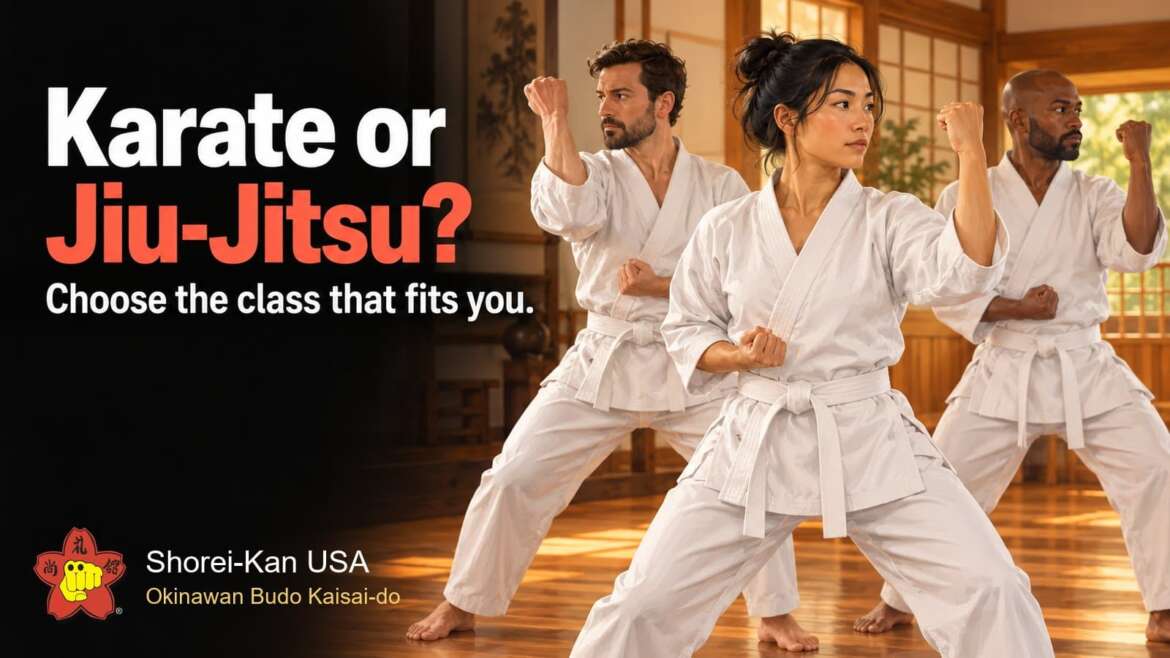
Okinawan Budo Kaisai-do, an evolution of Okinawan Goju-Ryu, and Brazilian jiu-jitsu are both complete martial arts, but they train different things. Kaisai-do focuses on standing technique: strikes, blocks, stances, and forms, with partner work introduced step by step. Brazilian jiu-jitsu, often called BJJ, focuses on grappling, mostly on the ground, and usually includes live sparring against a resisting partner as a regular part of class. Neither is better for everyone. The right choice depends on what you want to learn and how you want to train.
Northern Westchester has both traditional martial arts dojos and BJJ academies, so many people end up comparing the two. This guide explains the real differences in how classes work, so you can decide which kind of training fits you.
The Core Difference
The simplest way to see the difference is to look at what each art is built around.
Okinawan Budo Kaisai-do
Standing technique
Strikes, blocks, stances, footwork, and kata, with partner applications and sparring built in step by step.
Brazilian jiu-jitsu
Grappling
Positions, escapes, joint locks, and chokes, mostly on the ground, with live sparring commonly part of each class.
How the Two Compare, Side by Side
Individual schools vary, so treat this as a general guide. Okinawan Budo Kaisai-do is described here as it is taught at Shorei-Kan USA, a traditional Okinawan dojo. BJJ is described as it is commonly taught.
OKINAWAN BUDO KAISAI-DO
BRAZILIAN JIU-JITSU
Main focus
KAISAI-DO
Striking, blocking, stances, and footwork while standing
BJJ
Grappling and control, mostly on the ground
Typical class
KAISAI-DO
Basics, kata, partner exercises, and conditioning
BJJ
Warm-up, technique lesson, partner drilling, and often live rolling
Partner contact
KAISAI-DO
Prearranged partner work first, with sparring introduced progressively
BJJ
Close, continuous contact in most of the class
Sparring
KAISAI-DO
Shiai Kumite at Shorei-Kan, with protective gear and specific rules
BJJ
Rolling against a fully resisting partner
Solo practice
KAISAI-DO
Kata can be practiced alone
BJJ
Most practice requires a partner
Uniform
KAISAI-DO
Gi
BJJ
Heavier grappling gi, or athletic wear for no-gi classes
Progression
KAISAI-DO
Belt ranks. At Shorei-Kan, each level adds new kata, bunkai, and kiso kumite
BJJ
Adult belts from white through blue, purple, and brown to black, often with years between belts
What a Class Feels Like
An Okinawan Budo Kaisai-do class usually follows a set structure. Students bow in, warm up, and practice basic techniques in lines. Then they work on kata, the solo forms, and on partner exercises built from the same techniques. At Shorei-Kan, classes also include Daruma Taiso, a series of exercises and stretches used in Shorei-Kan training. The atmosphere is formal, with etiquette and customs that are part of the training itself.
A BJJ class commonly starts with a warm-up and a technique lesson on a specific position, followed by partner drilling. Many classes end with rounds of live sparring, called rolling, where partners try to apply techniques against full resistance. Contact is close and continuous throughout. Etiquette varies by academy, and many are less formal than a traditional dojo.
Both formats are demanding in different ways. Kaisai-do asks for precision, stance strength, and focus. BJJ asks for comfort with close physical contact and sustained effort against a partner.
Which Might Suit You?
You may prefer Okinawan Budo Kaisai-do if you want
- ☐ To learn striking, blocking, and footwork
- ☐ A structured curriculum with clear steps
- ☐ Partner contact introduced gradually
- ☐ Forms you can practice on your own
- ☐ Tradition, etiquette, and philosophy as part of training
- ☐ An option to study traditional weapons
You may prefer BJJ if you want
- ☐ To learn grappling and ground control
- ☐ Live sparring as a regular part of class
- ☐ Close, continuous partner contact
- ☐ Problem-solving against a resisting partner
- ☐ A less formal training atmosphere
- ☐ Training with no striking involved
If you checked items in both columns, that is common. Some people train in both arts, either at the same time or one after the other. What matters most is choosing a class you will actually attend and enjoy.
What About Self-Defense?
People often ask which art is better for self-defense. There is no simple answer, and anyone who offers one should be questioned.
The two arts train different ranges. Kaisai-do focuses on striking and defending while standing. BJJ focuses on controlling an opponent once the distance closes, especially on the ground. Each covers ground the other does not emphasize.
What matters more than the name of the art is how a school trains: whether techniques are practiced with a partner, whether there is a progression toward resistance, and whether the instructor is clear about what training can and cannot prepare you for. Ask any school you visit how they approach it.
Questions to Ask Any School You Visit
Whichever art you are leaning toward, these questions help you compare schools on the things that matter:
Ask Before You Choose
- What does a typical beginner class look like?
- When and how is sparring introduced?
- How much partner contact should I expect?
- What equipment or uniform do I need?
- How does belt advancement work?
- Is competition part of training or optional?
- Can I try a class before I commit?
The best way to decide is to watch or try a class at each. You will learn more in an hour on the mat or dojo floor than from any comparison online. For a broader checklist, read How to Choose a Martial Arts School in Cortlandt Manor.
Okinawan Budo Kaisai-do at Shorei-Kan USA
Shorei-Kan USA teaches Shorei-Kan Okinawan Budo Kaisai-do, a traditional Okinawan system rooted in Goju-Ryu. The school describes its approach as Budo, "the way to stop fighting," with technique taught for defense rather than aggression.
The curriculum is systematic. Step by step, students advance from learning how to walk to learning how to slide, and from defending against a punch to defending against weapons. At each level, students learn new kata, bunkai (kata applications practiced with a partner), and kiso kumite (preset two-person exercises), each a building block for the next. Shorei-Kan also practices Shiai Kumite, a sparring method created by Master Toshio Tamano that uses protective gear, specific rules, and defined striking points. To learn more about how forms connect to partner work, read Why Practice Kata?
The Adult program welcomes complete beginners and students with previous martial arts experience, including those coming from other arts. Seniors train in the regular Adult classes. The dojo also teaches Okinawan Kobudo, the study of traditional Okinawan weapons, and prior martial arts experience is not required to begin.
Classes at the Cortlandt Manor headquarters are led by Shihan Scott Lenzi, who began training in 1972 and holds the rank of 8th Dan in Budo Kaisai-do and 7th Dan in Okinawan Kobudo. Read more on the Tradition page.
Shorei-Kan USA at a Glance
Style
Shorei-Kan Okinawan Budo Kaisai-do, a traditional Okinawan system in the Goju-Ryu lineage
Programs
Junior and Adult programs (seniors welcome), and Okinawan Kobudo
Training
Kata, bunkai, kiso kumite, Shiai Kumite, and Daruma Taiso
Where
1062 Oregon Road, Cortlandt Manor. See the class schedule.
New members
Ask about current new-student offers when you call
Frequently Asked Questions
What is the main difference between Okinawan Budo Kaisai-do and Brazilian jiu-jitsu?
Kaisai-do focuses on standing technique such as strikes, blocks, stances, and forms. Brazilian jiu-jitsu focuses on grappling, mostly on the ground, using positions, escapes, joint locks, and chokes.
Is Kaisai-do or BJJ better for self-defense?
They train different ranges. Kaisai-do emphasizes striking and defense while standing, and BJJ emphasizes control once the distance closes. How a school trains, including partner work and resistance, matters more than the name of the art.
Which is better for a beginner?
Both welcome beginners. Kaisai-do usually introduces partner contact gradually, while BJJ involves close contact and often live sparring from early on. Consider which type of contact you are comfortable with, and try a class of each.
Can I train in both Kaisai-do and BJJ?
Yes. Some people train in both, and the two arts cover different skills. Make sure your schedule allows enough time to attend each consistently.
Does Shorei-Kan USA include sparring?
Yes. Shorei-Kan practices Shiai Kumite, a sparring method that uses protective gear, specific rules, and defined striking points. It is practiced in both the Kaisai-do and Kobudo classes. Ask the instructor how new students are introduced to it.
Try an Okinawan Budo Kaisai-do Class in Cortlandt Manor
The best way to know whether Okinawan Budo Kaisai-do fits you is to experience a class.
Ask about current new-student offers when you call, or see the special offers page.
Call Shorei-Kan USA at 914-739-7804 or use the contact page to ask about the Adult class and current class times.
Okinawan Budo Kaisai-do
Curious About Okinawan Budo Kaisai-do?
See how an Okinawan Budo Kaisai-do class is taught, from basics and kata to partner work. Contact the Cortlandt Manor dojo to ask about current Adult class times.
PLAN YOUR VISIT CALL 914-739-7804
1062 Oregon Road, Cortlandt Manor, NY 10567