
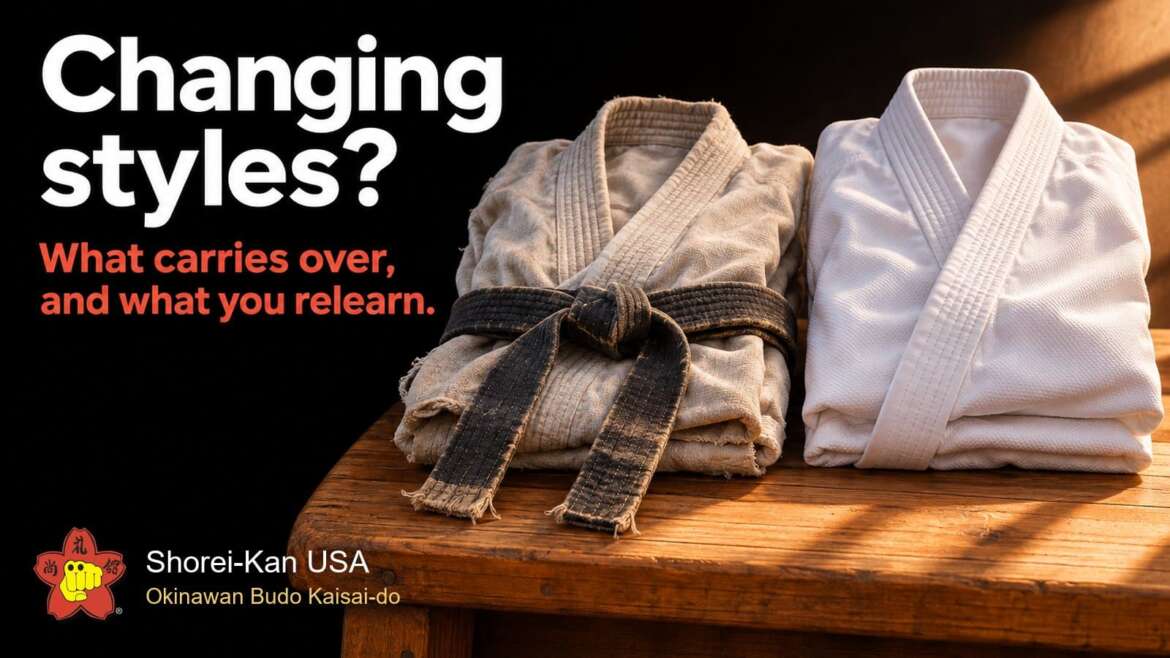
When you switch martial arts styles, your discipline, conditioning, etiquette, and ability to learn carry over. Terminology, stances, kata, and the way techniques are timed and applied usually need relearning. The hardest part is often not learning the new material. It is setting aside habits you have practiced for years. Tell the instructor what you trained, approach the new system with an open mind, and expect your experience to help even when the details are different.
People change styles for many reasons: a move, a school that closed, a new interest, or simply finding a dojo that fits better. Whatever the reason, it can be humbling to feel like a beginner again after years of training. It is also one of the best ways to deepen your understanding of the martial arts.
What Carries Over, What Adjusts, What You Relearn
Your experience does not disappear when you walk into a new dojo. It helps to sort it into three groups.
Carries over
Your head start
- Discipline and work ethic
- Conditioning and flexibility
- Comfort with dojo etiquette
- Control with a partner
- Knowing how to learn a kata
Adjusts
Familiar, but done differently
- Basic punches, blocks, and kicks
- Stance depth and width
- Hip and body mechanics
- Timing and rhythm
- Distance with a partner
Relearn
New to you
- Kata and their order
- Terminology and commands
- Applications and partner forms
- Sparring format and rules
- The system's history and philosophy
The middle group is where most of the work happens. These are the things you already know how to do, just not the way your new school does them.
The Hard Part Is Unlearning
Learning a new kata is straightforward. Changing a stance you have practiced thousands of times is not. Old habits show up when you are tired, when you speed up, and when you are not thinking about them.
A few approaches help:
- Slow down. Speed brings back old habits. Practicing slowly gives you time to do it the new way.
- Ask how it differs. "How is this different from what I learned before?" helps the instructor pinpoint what to correct.
- Treat corrections as information. A correction is not a judgment of your past training. It is a description of how this system does things.
- Expect some back-and-forth. Old and new habits will trade places for a while. That is part of the process.
Shoshin, or "beginner's mind," is a Japanese idea that describes approaching something with openness and no preconceptions, even when you already know a great deal about it.
It may be the most useful mindset for anyone changing styles.
Where You Are Coming From Matters
How big the change feels depends a lot on what you trained before. Every school is different, so treat these as general tendencies rather than rules.
FROM A LONGER-RANGE STYLE
Such as Shotokan
Styles known for long, deep stances and long-range techniques may feel quite different from an art that emphasizes closer range and circular movement. Expect to adjust your stances and distance.
FROM ANOTHER OKINAWAN STYLE
Including other Goju-Ryu schools
Much may feel familiar, but kata versions, teaching order, and partner exercises can still differ from school to school within the same broad tradition.
FROM ANOTHER MARTIAL ART
Such as taekwondo or kickboxing
Your fitness, footwork, and partner experience help. Kata, traditional etiquette, and stance work may be the biggest adjustments.
No style is better or worse for this. Each one simply builds different habits, and each brings something useful to a new school.
What Makes Goju-Ryu Distinct
Shorei-Kan is rooted in Okinawan Goju-Ryu, so it helps to know what that tradition is generally known for. Goju-Ryu means "hard-soft style."
Goju-Ryu Is Generally Known For
Hard and soft
Closed-hand, linear techniques combined with open-hand, circular ones
Closer range
An emphasis on techniques used at close distance
Breathing
Careful attention to breathing in kata
If your previous style worked mostly at long range with linear techniques, the circular movements and closer distance may take the most getting used to. If you already trained in Goju-Ryu, the classical forms may feel familiar, though the way they are taught and applied can vary between schools.
What Is Unique About the Shorei-Kan System
Even students who come from another Goju-Ryu school will find new material at Shorei-Kan. According to the school, Master Seikichi Toguchi created the Shorei-Kan system to give students a way to make systematic progress in Goju-Ryu.
Shorei-Kan kata and two-person forms first
Before the classical Goju-Ryu forms, students learn a series of kata and two-person forms unique to Shorei-Kan.
Kata, bunkai, and kiso kumite at every level
From white belt to black belt and beyond, each level adds new kata, their applications, and preset two-person exercises.
Shiai Kumite
A sparring method created by Master Toshio Tamano, using protective gear, specific rules, and defined striking points. It may differ from point sparring you have done before.
Kaisai no Genri
Within the Shorei-Kan tradition, kata is studied for the techniques it contains, a principle the school calls Kaisai no Genri.
For an experienced student, this is one of the most interesting parts of changing to Shorei-Kan. The material is new, and the way kata connects to partner work may give you a different lens on techniques you already know. To learn more, read Why Practice Kata? How Forms Connect to Partner Work in Shorei-Kan.
What About Your Rank?
Rank is often the most sensitive part of changing styles. Schools handle it in different ways. Some ask experienced students to begin at a set level and advance as they learn the new material. Others review a student's background before deciding. Policies vary, so ask directly.
It helps to separate what you earned in your previous style from where you are in a new system. Your past rank reflects real work. Your placement in a new school reflects how much of that school's material you know. Both can be true at the same time. For more on this, read Returning to Martial Arts After Years Away: What to Discuss Before Restarting.
The First Conversation With Your New Instructor
Your Conversation Card
Tell them
- The style and school you trained in
- How long you trained and your highest rank
- How long ago you last trained
- Why you are changing styles
- Any injuries or limitations
Ask them
- How do you place students from other styles?
- What belt should I wear to start?
- What will feel most different for me?
- What should I focus on first?
- How is sparring introduced here?
Be honest about both your strengths and your gaps. The more the instructor knows, the more useful their corrections will be.
Frequently Asked Questions
Do I have to start over at white belt if I change martial arts styles?
It depends on the school. Some ask experienced students to start at a set level and advance as they learn the new material, and others review your background first. Tell the instructor your history and ask how they place students from other styles.
What carries over when you switch martial arts styles?
Discipline, conditioning, flexibility, dojo etiquette, partner control, and your ability to learn kata usually carry over. Basic techniques carry over too, though they may need adjusting.
What is the hardest part of changing martial arts styles?
For many students, it is unlearning habits. Stances, timing, and techniques practiced for years tend to return when you are tired or moving fast. Slowing down and asking how the new style differs helps.
How is Goju-Ryu different from other martial arts styles?
Goju-Ryu, meaning "hard-soft style," is generally known for combining linear and circular techniques, an emphasis on closer range, and careful attention to breathing in kata. Individual schools vary.
Is Shorei-Kan different from other Goju-Ryu schools?
Yes. Shorei-Kan students learn a series of kata and two-person forms unique to Shorei-Kan before the classical Goju-Ryu forms, and they study kata, bunkai, and kiso kumite together at each level. Shorei-Kan also practices Shiai Kumite.
Training at Shorei-Kan USA
Shorei-Kan USA's Adult program welcomes complete beginners as well as students with previous martial arts experience. Training follows a systematic, progressive approach to Okinawan Budo Kaisai-do, building through individual techniques, kata, prearranged sequences, partner practice, and practical applications. Seniors train in the regular Adult classes.
The dojo also teaches Okinawan Kobudo, the study of traditional Okinawan weapons. Prior martial arts experience and Shorei-Kan enrollment are not required to begin, which makes it a natural option for experienced martial artists who want to add something new.
Classes at the Cortlandt Manor headquarters are led by Shihan Scott Lenzi, who began training under Shihan Toshio Tamano in 1972 and holds the rank of 8th Dan in Budo Kaisai-do and 7th Dan in Okinawan Kobudo. Read more about the lineage on the Tradition page.
For Experienced Students at a Glance
System
Shorei-Kan Okinawan Budo Kaisai-do, in the Okinawan Goju-Ryu lineage
Programs
Adult program, open to experienced students, and Okinawan Kobudo, with no prior martial arts training required
Where
Cortlandt Manor headquarters, 1062 Oregon Road. See the class schedule.
New students
Ask about current offers when you call
Try a Class in Cortlandt Manor
If you have trained in another style, the best way to see how Shorei-Kan compares is to take a class.
Ask about current new-student offers when you call, or see the special offers page.
Call Shorei-Kan USA at 914-739-7804 or use the contact page to tell the dojo about your previous training and ask about the right class.
Your Experience Counts
Trained in Another Style?
Tell the instructor about your background and see how the Shorei-Kan system compares. Contact the Cortlandt Manor dojo to ask about the right class for you.
PLAN YOUR VISIT CALL 914-739-7804
1062 Oregon Road, Cortlandt Manor, NY 10567