
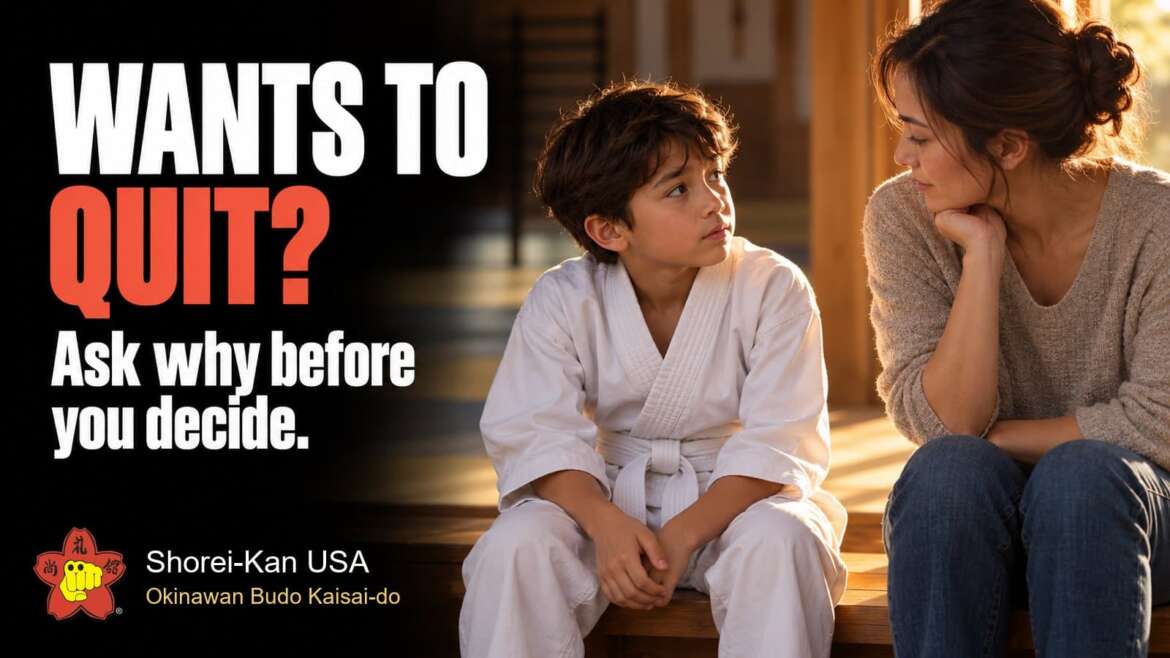
When your child says they want to quit martial arts, start by finding out why. The reason usually points to the right answer. Frustration with a skill, a friend moving up a belt, a crowded schedule, or a real loss of interest each call for something different. The choice is rarely just "keep going" or "stop." Adjusting, pausing, or setting a short goal are often better options than either.
Most parents who enroll a child in martial arts hear "I don't want to go" at some point. It can bring up guilt from both directions: worry about teaching a child to give up, and worry about forcing them into something they do not enjoy. Taking a little time to understand what is going on makes the decision easier and fairer to everyone.
"I Want to Quit" Is Rarely the Whole Story
Children often say they want to quit when something specific is bothering them. They may not have the words for it yet, or they may not connect the feeling to its cause. Your job at this point is not to decide. It is to find out what changed.
These are some of the most common reasons parents hear, once they ask:
"It's too hard"
A new kata or technique is frustrating, and progress feels slow.
"Everyone else moved up"
A friend or sibling earned a new belt first, and your child feels left behind.
"I'm too tired"
School, other activities, or class time are making the week feel crowded.
"My friend stopped going"
The social side of class has changed.
"I don't like it anymore"
Your child's interests have moved on to something else.
Something about class
A problem with another student, a partner drill, or how they are treated.
Some of these are temporary and solvable. Others are real signs that martial arts training is no longer the right fit. You will not know which until you ask.
Questions to Ask Your Child
Pick a calm moment, not the car ride right after a hard class. Keep the questions open so your child can explain in their own words.
Start the Conversation
"What part of class don't you like right now?"
"Is there a part you still enjoy?"
"When did it start feeling this way?"
"Did something happen in class?"
"What would make it better?"
"What would you want to do instead?"
Listen more than you respond. If the answers are vague, that is fine. You can come back to it in a day or two, or watch a class to see for yourself.
If your child describes being mistreated, singled out, or hurt, take it seriously and address it directly with the instructor. That is a different conversation from a child losing interest. For what respectful teaching looks like, read Martial Arts Discipline Without Humiliation: What Parents Can Look For.
Questions to Ask Yourself
Parents bring their own hopes to a child's activity. It helps to be honest about them before deciding.
A Parent's Self-Check
- ☐ Were martial arts classes my child's idea, mine, or both of ours?
- ☐ Is this a pattern, or did it start after one hard class?
- ☐ Has anything else changed lately, such as school, friends, or schedule?
- ☐ Am I comparing my child's progress with another child's?
- ☐ What do I most want my child to get from martial arts?
- ☐ Could my child get that from something they would enjoy more?
None of these answers makes the decision for you. They help you separate what your child needs from what you hoped for.
Talk to the Instructor
The instructor sees your child in class every week and may notice things you cannot. A short conversation outside of class often clears things up.
Questions for the Instructor
- How does my child seem in class lately?
- Is there a skill they are stuck on?
- What is a realistic next goal for them?
- Would a different class time or group make sense?
- What options does the school have if we need a break?
Instructors have usually seen this many times. Many can suggest a small change, such as a clear next goal or extra help with one technique, that makes class feel doable again.
Four Options, Not Two
The decision is not just "keep going" or "quit." Most families end up choosing one of four paths.
OPTION 1
Continue with a goal
Agree on one clear goal and a date to check in again.
OPTION 2
Adjust
Change the class time, the number of classes, or the focus.
OPTION 3
Pause
Take a planned break with a time to revisit the decision.
OPTION 4
Stop well
End on a good note and move on to something new.
Matching the reason to the response
IF THE REASON IS
Frustration with a skill
CONSIDER
Continue with a goal. Ask the instructor for one focus point, and give it a few more weeks.
IF THE REASON IS
A friend or sibling moved up
CONSIDER
Continue with a goal. Focus on your child's own progress and what they need for their next step.
IF THE REASON IS
Tired or overscheduled
CONSIDER
Adjust. A different class time or fewer activities overall may solve it.
IF THE REASON IS
A friend stopped going
CONSIDER
Continue with a goal or adjust. Give your child time to build new connections in class.
IF THE REASON IS
Lost interest for a while
CONSIDER
Pause or stop well. Interest that has faded over months is worth respecting.
IF THE REASON IS
A problem in class
CONSIDER
Talk to the instructor first. The next step depends on what you learn.
Avoid Deciding on the Worst Day
A decision made right after a frustrating class usually reflects that class, not the whole experience. A simple rule helps: do not decide on a bad day.
Wait until your child has had a better class, or at least a few calm days, before making a final choice. If they still want to stop when they are not upset, that tells you something real.
If Your Child Continues
Keep the plan simple:
- Set one short-term goal with the instructor, such as learning the next section of a kata.
- Pick a date to check in, a few weeks or a month out.
- Notice effort and progress, not just belt changes.
- Avoid comparing your child with friends or siblings.
When the check-in date comes, ask again how they feel. The answer may be different once the frustration has passed.
If forgetting kata is part of the frustration, read I Keep Forgetting Martial Arts Movements: Does That Mean No Progress?
If Your Child Stops
Stopping is not a failure when it is done thoughtfully. A few steps help it end well:
- Talk with the instructor before the last class rather than simply not returning.
- Finish any commitment you have already agreed to, if it is reasonable.
- Help your child say thank you or say goodbye in their own way.
- Talk about what they learned and what they are proud of.
- Leave the door open. Some children return to martial arts later, when the timing is right.
Junior Classes at Shorei-Kan USA
Shorei-Kan USA's Junior program introduces younger students to the fundamentals of Okinawan Budo Kaisai-do. Instruction begins with foundational movement and technique, then progresses gradually as students become ready for more complex material.
The school describes its curriculum as one that allows children to practice slowly, as in a game of sport. Junior classes use age-appropriate pacing and close instructor supervision, with an approach that is structured and nonaggressive and emphasizes careful practice, courtesy, and patience. Those principles come from the school's Budo philosophy and Dojo Kun, which includes "Learn to be patient" and "Strive to be a better person."
Classes at the Cortlandt Manor headquarters are led by Shihan Scott Lenzi, who began training in 1972 and holds the rank of 8th Dan in Budo Kaisai-do and 7th Dan in Okinawan Kobudo. If your child is enrolled and struggling, the instructor is the best first call.
Junior Classes at a Glance
Approach
Age-appropriate pacing, close supervision, structured and nonaggressive
Cortlandt Manor
Headquarters, 1062 Oregon Road. See the class schedule for Junior times.
Greenwood Lake
Junior Class, Tuesdays, 5:00 to 5:30 p.m.
Questions
Call 914-739-7804 to talk with the dojo about your child's training.
If you are still deciding whether to start martial arts at all, read Is My Child Ready for Structured Martial Arts Classes?
Frequently Asked Questions
Should I make my child stay in martial arts?
Find out why they want to quit first. If the reason is temporary frustration, continuing with a clear goal often helps. If their interest has faded over months, forcing them to stay rarely helps. Decide together when neither of you is upset.
How long should a child try martial arts before quitting?
There is no set rule. Many families agree to finish a current commitment or give it a few more weeks with a specific goal before deciding. Avoid making the choice right after a hard class.
What if my child wants to quit because friends moved up a belt?
Talk about your child's own progress and ask the instructor what they need for their next step. Comparison with peers is a common trigger, and a clear personal goal often helps.
Can my child take a break from martial arts and come back?
Some children return to martial arts after time away. Ask the dojo what options are available if you need a break, and set a time to revisit the decision.
What should I do if my child says something happened in class?
Listen carefully and talk with the instructor privately. If your child describes being hurt or mistreated, address it directly and right away.
Talk With the Dojo in Cortlandt Manor
Whether your child is new to martial arts or thinking about stopping, a conversation with the instructor is the best next step.
Ask about current new-student offers when you call, or see the special offers page.
Call Shorei-Kan USA at 914-739-7804 or use the contact page to talk about Junior classes.
Every Child Is Different
Want to Talk It Through?
The instructor sees your child in class every week. Contact the Cortlandt Manor dojo to talk about your child's training and what might help.
CONTACT THE DOJO CALL 914-739-7804
1062 Oregon Road, Cortlandt Manor, NY 10567