
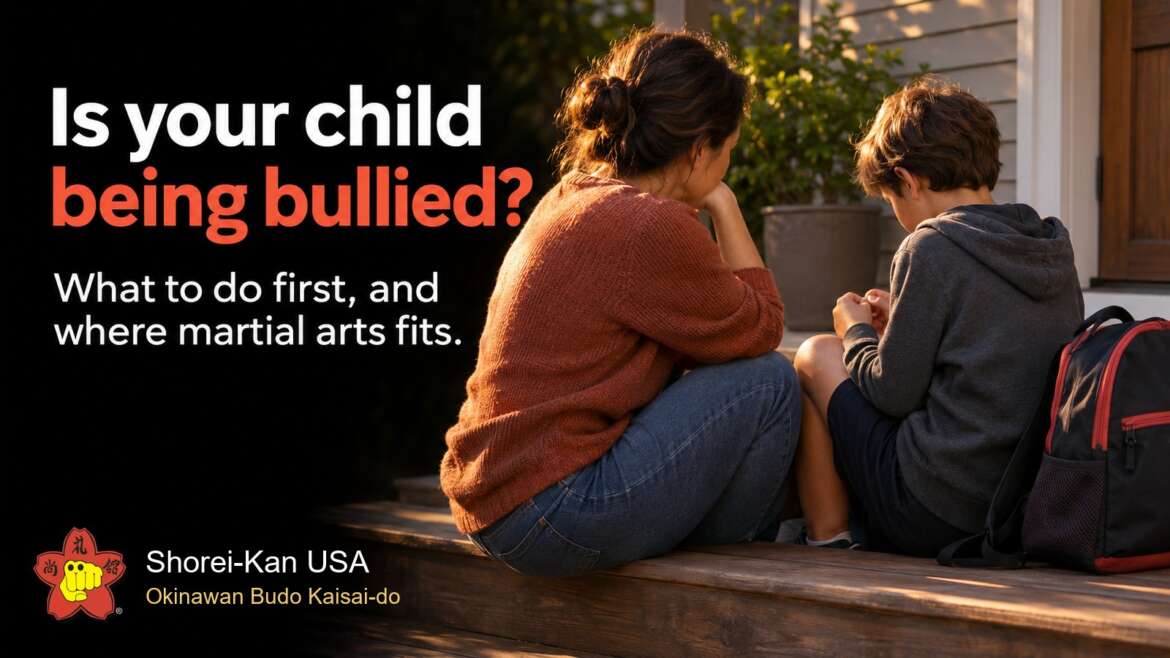
Martial arts can give a bullied child a place to build skills, confidence, and friendships, but it does not stop bullying on its own. Stopping bullying is the job of the adults around your child: you, the school, and anyone else responsible for where it happens. Start by listening to your child, writing down what happened, and reporting it to the school. Then, if your child is interested, martial arts can be a positive part of how they recover and grow.
When you learn your child is being bullied, it is natural to want to do something right away. Many parents think of martial arts. That instinct makes sense, and training can help. But it works best as support alongside a proper response, not as a replacement for one.
Two Jobs, Not One
It helps to separate two different jobs. Martial arts training belongs to the second one.
Job 1: Stop the bullying
Adults are responsible for this
- Listen to your child
- Document what happened
- Report it to the school
- Follow up until it is addressed
Job 2: Support your child
Where martial arts may help
- Activities they enjoy
- Skills they can be proud of
- New friendships and belonging
- A steady, respectful routine
Your child should never be made responsible for stopping the bullying themselves. That is true whether or not they take martial arts.
Step 1: Listen First
How you respond when your child tells you matters. Stay calm, and let them tell the story in their own words.
Things That Help to Say
"Thank you for telling me."
"This is not your fault."
"Can you tell me what happened?"
"We are going to work on this together."
Avoid promising to keep it a secret. Your child needs to know you may have to tell the school so adults can help. Also avoid telling them to simply ignore it or to fight back. Both put the burden on your child.
Step 2: Write It Down
A clear record makes it easier for the school to act.
What to Record
- ☐ The date, time, and place of each incident
- ☐ What was said or done, in your child's words
- ☐ Who was involved and who saw it
- ☐ Screenshots of any online messages or posts
- ☐ Who you reported it to, and when
For online bullying, the federal StopBullying.gov site also recommends reporting the content to the platform where it appeared.
Step 3: Report It to the School
Contact your child's teacher, school counselor, or principal. Ask what the school will do, and when you should expect to hear back.
In New York: The Dignity for All Students Act
New York's Dignity for All Students Act, known as DASA, requires public schools to provide an environment free from harassment, bullying, and discrimination, and to address incidents that are reported.
Each school has at least one Dignity Act Coordinator. Their contact information should be listed on the district website or in the Code of Conduct. You can report to the coordinator or to any school staff member, including the principal.
DASA can also apply to conduct that happens off school property, including online, when it is likely to cause substantial disruption at school.
If the problem continues, follow up in writing. If the school does not address it, StopBullying.gov advises that parents can contact the state department of education. If a crime has occurred or someone is at immediate risk of harm, call 911.
Watch How Your Child Is Doing
Bullying can affect how a child feels well beyond school hours. If your child seems persistently sad, anxious, or withdrawn, talk with the school counselor or your pediatrician. If your child ever talks about hopelessness or hurting themselves, call or text 988, the Suicide and Crisis Lifeline, right away.
What Martial Arts Can Offer
Once the school is involved and your child feels supported, an activity they enjoy can be a real help. StopBullying.gov encourages parents to help children take part in activities they love, noting that these activities "can build confidence and friendships that help protect kids from bullying."
Martial arts training is one option. Here is what the research and the nature of training suggest it can and cannot do.
What martial arts can offer
- ✓ Skills your child can see themselves improving
- ✓ A group outside school with a shared interest
- ✓ A structured, respectful environment
- ✓ Clear goals and visible progress through belts
- ✓ Practice staying calm and focused under pressure
What martial arts cannot do
- ✗ Stop the bullying by itself
- ✗ Replace reporting to the school
- ✗ Guarantee a change in confidence or personality
- ✗ Make your child responsible for fixing it
- ✗ Work overnight
What the research says
Research on martial arts and children's wellbeing is encouraging, but it is important to read it carefully.
A SCHOOL-BASED TRIAL
A randomized controlled trial of a 10-week martial arts program with 283 students ages 12 to 14 in Australia found small improvements in resilience and self-efficacy compared with students who did not take part. The study did not measure bullying itself. (Moore, Woodcock, and Dudley)
A 2025 REVIEW OF 16 TRIALS
A systematic review and meta-analysis of 16 randomized controlled trials found that martial arts programs increased children's prosocial behavior and reduced aggressive behavior. (Adolescent Research Review, 2025)
These studies looked at structured programs, not at any particular school, and they measured things like resilience and behavior rather than whether bullying stopped. They support martial arts as a healthy activity. They do not show that enrolling in martial arts ends bullying.
Martial Arts Are Not About Fighting Back
Some parents hope martial arts training will teach their child to hit back. Traditional martial arts are not taught that way, and a good school will tell you so.
In a traditional dojo, technique is taught for defense, with an emphasis on self-control. Getting into a physical fight at school can also lead to discipline for your child and does not solve the underlying problem. The most useful message for a child being bullied is simple: get to safety and tell an adult.
When you talk with your child about starting martial arts, frame it as something fun to try and a place to learn, not as preparation to fight.
Questions to Ask a Dojo
If you are considering martial arts for a child who has been bullied, a few questions will tell you a lot about a school:
Ask Before You Enroll
- How do you teach children when to use, and when not to use, what they learn?
- How are new students welcomed into the class?
- How do you handle conflict between students in class?
- Can I share what my child has been going through, privately?
- Can my child try a class before we enroll?
Be cautious of any school that promises martial arts will stop bullying or encourages children to fight. A trustworthy instructor will be honest about what training can and cannot do. For what respectful teaching looks like, read Martial Arts Discipline Without Humiliation: What Parents Can Look For. If your child is shy or hesitant about a new class, read My Child Is Shy: How Can We Tell Whether a Martial Arts Class Feels Right?
Shorei-Kan USA's Approach
Shorei-Kan describes Okinawan Budo Kaisai-do as a Budo, which it translates as "the way to stop fighting." The school presents martial arts as a way to train the mind and body while learning technique for defense rather than aggression.
That philosophy is reflected in the school's Dojo Kun, its guiding principles, which include "Always be courteous and humble," "Cultivate a peaceful spirit," and "Learn to be patient."
The Junior program introduces younger students to the fundamentals of Okinawan Budo Kaisai-do with age-appropriate pacing and close instructor supervision. The school describes the approach as structured and nonaggressive, with an emphasis on careful practice, courtesy, patience, and the use of technique for defense.
Classes at the Cortlandt Manor headquarters are led by Shihan Scott Lenzi, who began training in 1972 and holds the rank of 8th Dan in Budo Kaisai-do and 7th Dan in Okinawan Kobudo.
Junior Classes at a Glance
Philosophy
Budo, "the way to stop fighting," with technique taught for defense
Approach
Age-appropriate pacing, close supervision, structured and nonaggressive
Cortlandt Manor
Headquarters, 1062 Oregon Road. See the class schedule for Junior times.
Greenwood Lake
Junior Class, Tuesdays, 5:00 to 5:30 p.m.
Frequently Asked Questions
Will martial arts stop my child from being bullied?
Not on its own. Stopping bullying requires adults, especially the school, to respond. Martial arts can support your child by building skills, confidence, and friendships, but it should be added to a proper response, not used in place of one.
Should I tell my child to fight back?
No. Physical fights can lead to school discipline and do not solve the problem. Teach your child to get to safety and tell a trusted adult, and report the bullying to the school.
Who do I report bullying to in New York?
Contact your child's teacher, counselor, principal, or the school's Dignity Act Coordinator. New York's Dignity for All Students Act requires public schools to address reported bullying and harassment.
Is martial arts training good for a child who has been bullied?
It can be, if your child is interested. Research on structured martial arts programs has found improvements in resilience, self-efficacy, and prosocial behavior. Look for a school that teaches technique for defense and is honest about what training can do.
How soon will martial arts make a difference?
There is no set timeline. Every child is different. Focus on whether your child enjoys class and feels welcome, and keep working with the school on the bullying itself.
Talk With the Dojo in Cortlandt Manor
If you think martial arts could be a good fit for your child, start with a conversation and a visit.
Ask about current new-student offers when you call, or see the special offers page.
Call Shorei-Kan USA at 914-739-7804 or use the contact page to talk about Junior classes.
A Place to Grow
Could Martial Arts Be a Good Fit?
Start with a conversation. Contact the Cortlandt Manor dojo to talk about your child, the Junior program, and trying a class.
CONTACT THE DOJO CALL 914-739-7804
1062 Oregon Road, Cortlandt Manor, NY 10567