
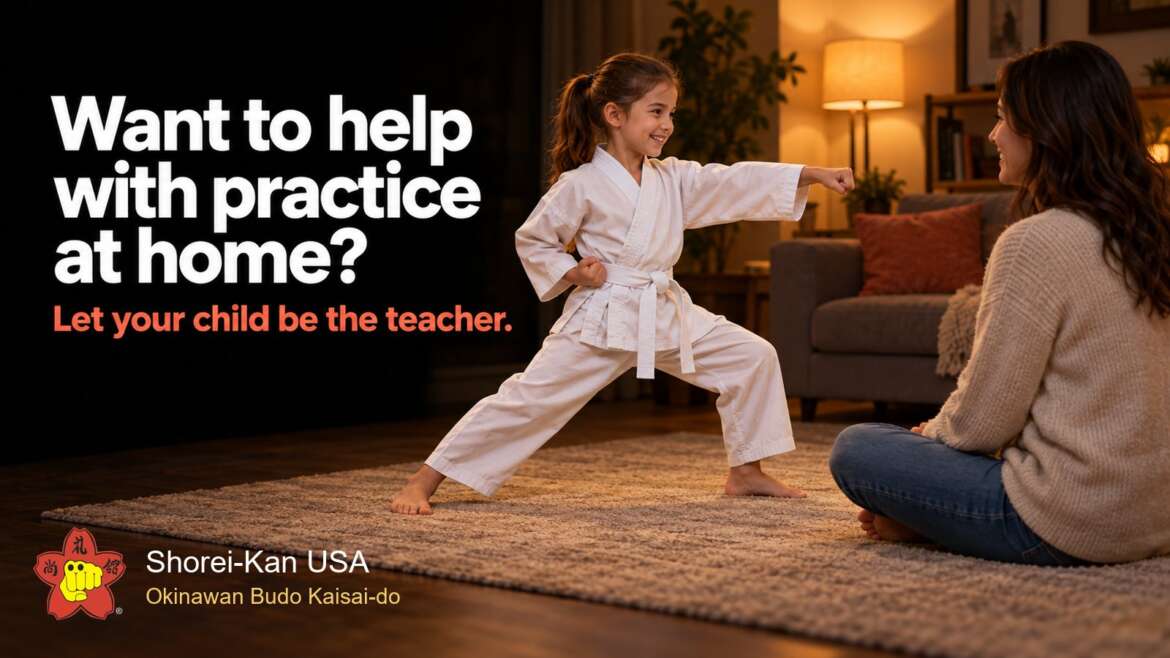
The best way to help your child practice martial arts at home is to support the practice, not teach it. Ask the instructor what is worth reinforcing, let your child lead short practice sessions on material they have already learned, and praise effort rather than correcting technique. Leave the corrections to the instructor. Your role is encouragement, interest, and making it easy to show up.
Many parents want to help, especially when a child is struggling with a new kata or getting ready for their next belt. That instinct is a good one. The challenge is helping in a way that builds your child's confidence instead of adding a second voice telling them what they did wrong.
Why "Second Instructor" Usually Backfires
When a parent starts correcting technique at home, a few things tend to happen. The child hears two sets of instructions that may not match. Practice starts to feel like a test. And training slowly becomes something the parent owns rather than something the child owns.
Research on youth sports supports this. A 2024 systematic review in Frontiers in Psychology on parents and young athletes' motivation found that when parents support a child's own choices and emphasize effort and learning, children tend to show stronger, more self-driven motivation. Parental pressure and a controlling style were linked to lower motivation, burnout, and boredom.
The takeaway is not to step away. It is to take on a different role.
Two Roles, One Goal
The instructor's job
- Teach new techniques and kata
- Correct form and technique
- Decide what your child works on next
- Judge readiness for the next belt
Your job
- Show interest in what they are learning
- Encourage effort and consistency
- Make it easy to get to class ready
- Listen when practice is frustrating
When each person sticks to their role, your child gets clear instruction from one place and steady support from another.
Start by Asking the Instructor
Before you help at home, find out what would actually be useful. A short conversation keeps you from reinforcing something the instructor is trying to change.
Questions for the Instructor
- Is home practice helpful for my child right now?
- What one thing would be worth reviewing this week?
- Is there anything we should not practice at home?
- How can I encourage practice without correcting my child?
The answer may be simple: "Have them walk through the first part of their kata a few times." That gives your child a clear, small task, and it gives you a way to help without guessing.
Let Your Child Be the Teacher
One of the easiest ways to support practice is to flip the roles. Ask your child to show you what they learned. Explaining a movement helps them remember it, and it puts them in charge.
STEP 1
Pick one thing
Choose something the instructor assigned or recently taught.
STEP 2
Ask them to show you
"Can you teach me the stance you learned today?"
STEP 3
Ask, do not correct
"What did your instructor say about your feet?"
STEP 4
Stop while it is fun
A few minutes is enough. End on a good note.
If you notice something that looks off, resist the urge to fix it. Instead, suggest your child ask the instructor about it at the next class. That keeps corrections in one place.
What to Say Instead
Small changes in wording make a big difference in how practice feels. Here are a few swaps:
INSTEAD OF
"Your stance is wrong."
TRY
"Show me the stance you learned today."
INSTEAD OF
"Do it again, and do it right this time."
TRY
"Want to try that part one more time?"
INSTEAD OF
"You need to practice more if you want your next belt."
TRY
"What is your instructor having you work on?"
INSTEAD OF
"Great job!"
TRY
"You kept going even when you lost your place."
INSTEAD OF
"That's not how they do it on the video."
TRY
"Let's ask your instructor how they want it done."
Specific praise about effort tells your child exactly what you noticed. It also keeps the focus on what they can control.
When Practice Gets Frustrating
Sooner or later, your child will get stuck on a kata or feel like they cannot get a movement right. How you respond in that moment matters more than the practice itself.
When Frustration Shows Up
- ✓ Stop the practice. Pushing through frustration rarely helps.
- ✓ Let them know that getting stuck is a normal part of learning.
- ✓ Suggest working on just one small section next time.
- ✓ Help them write down a question to ask the instructor.
Forgetting parts of a kata between classes is common for beginners. For more on why it happens and what helps, read I Keep Forgetting Martial Arts Movements: Does That Mean I'm Not Making Progress? For more on why forms matter, see Why Practice Kata?
During Class: Watch, Do Not Coach
If you watch your child's class, try to stay a quiet presence. Calling out tips from the side of the room can confuse your child and contradict what the instructor just said. It can also make your child more self-conscious about being watched.
Save your comments for later, and keep them positive. "I liked watching you work with your partner" means more after class than any technical tip during it.
Other Ways to Support Your Child's Training
Some of the most useful support has nothing to do with technique.
A Parent's Support Checklist
- ☐ Get to class on time and ready to train
- ☐ Help keep attendance consistent from week to week
- ☐ Ask about class with real curiosity
- ☐ Notice effort, not just belts
- ☐ Avoid comparing your child with other students
- ☐ Keep in touch with the instructor about progress
- ☐ Model patience when learning something new yourself
If your child is feeling behind because friends have moved up, read Why Is My Child Still on the Same Martial Arts Belt When Friends Have Moved Up?
Junior Classes at Shorei-Kan USA
Shorei-Kan USA's Junior program introduces younger students to the fundamentals of Okinawan Budo Kaisai-do. Instruction begins with foundational movement and technique, then progresses gradually as students become ready for more complex material. Junior classes use age-appropriate pacing and close instructor supervision, with an approach that is structured and nonaggressive.
At each level, students learn new kata, bunkai (kata applications practiced with a partner), and kiso kumite (preset two-person exercises), each a building block for the next. That structure gives parents a clear question to ask: which of these is my child working on now?
The school's Dojo Kun includes "Learn to be patient" and "Develop the spirit and techniques equally." Those principles apply at home as much as in the dojo, for parents and students alike.
Classes at the Cortlandt Manor headquarters are led by Shihan Scott Lenzi, who began training in 1972 and holds the rank of 8th Dan in Budo Kaisai-do and 7th Dan in Okinawan Kobudo.
Junior Classes at a Glance
Approach
Age-appropriate pacing, close supervision, structured and nonaggressive
Each level adds
New kata, bunkai, and kiso kumite
Cortlandt Manor
Headquarters, 1062 Oregon Road. See the class schedule for Junior times.
Greenwood Lake
Junior Class, Tuesdays, 5:00 to 5:30 p.m.
Frequently Asked Questions
Should my child practice martial arts at home?
Short practice on material the instructor has already taught can help your child remember it. Ask the instructor whether home practice is useful right now and what to focus on.
How can I help if I don't know martial arts?
You do not need to know martial arts. Ask your child to show you what they learned, ask questions instead of correcting, and praise their effort. Leave technical corrections to the instructor.
Should I correct my child's technique at home?
It is usually better not to. Corrections from two sources can confuse a child. If something looks off, encourage your child to ask the instructor at the next class.
How long should home practice be?
A few minutes is often enough. Stop while your child is still enjoying it. Consistent, short practice tends to work better than long sessions.
Is it okay to use videos for home practice?
Different schools teach kata differently, so a video may not match what your child is learning. Ask the instructor before using outside videos, and stick to material taught in class.
Talk With the Dojo in Cortlandt Manor
The instructor can tell you exactly what your child is working on and how you can help at home.
Ask about current new-student offers when you call, or see the special offers page.
Call Shorei-Kan USA at 914-739-7804 or use the contact page to talk about Junior classes.
Support Without Pressure
Want to Know How to Help?
The instructor can tell you what your child is working on and what is worth reinforcing at home. Contact the Cortlandt Manor dojo to talk about Junior classes.
CONTACT THE DOJO CALL 914-739-7804
1062 Oregon Road, Cortlandt Manor, NY 10567