
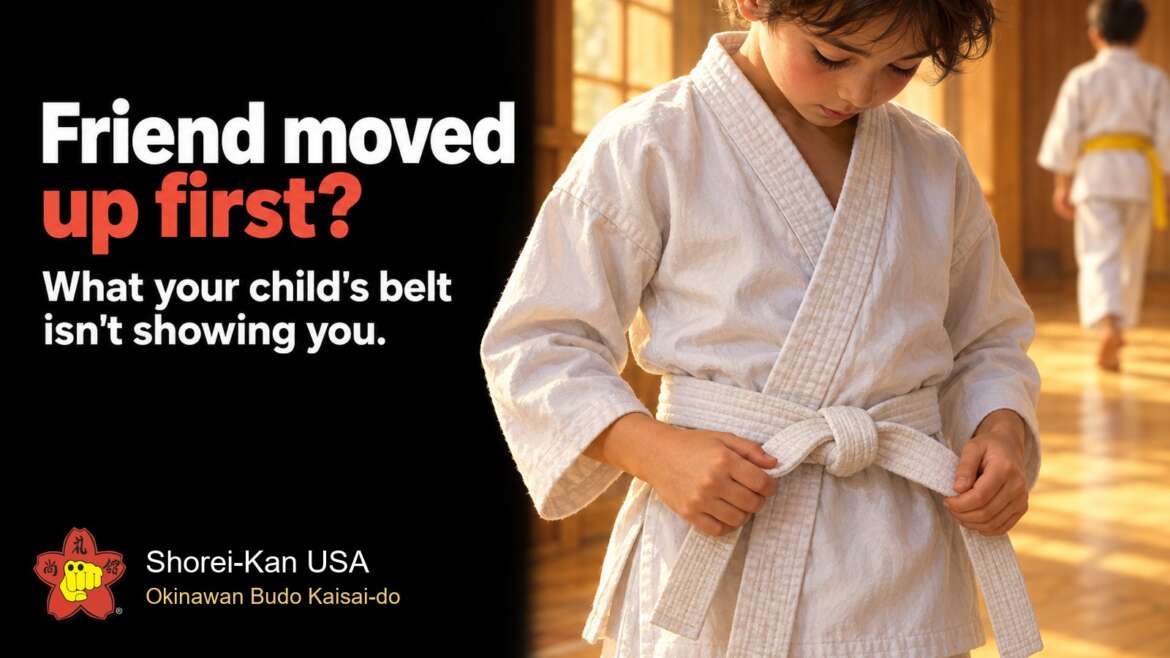
Children move through belts at different speeds because they start at different times, attend at different rates, and learn different skills at different paces. In a school where belts are earned by showing the material, a friend moving up first usually means that friend is ready for their next step, not that your child is falling behind. The most useful thing you can do is ask the instructor what your child needs for their next belt, and help your child focus on that instead of on the comparison.
It can still sting. Your child may come home disappointed or embarrassed. You may wonder whether something is wrong, whether your child is being overlooked, or whether you chose the wrong school. Those feelings are understandable. A clear conversation usually answers them.
Why Belts Move at Different Speeds
Two children who seem to be at the same level can be on very different paths. These are some of the most common reasons a friend moves up first:
Different start dates
A few weeks or months of extra training can make a real difference at the early belts.
Different attendance
More classes mean more repetition, and missed weeks add up.
One skill needs more work
A kata section, a stance, or a partner exercise may not be ready yet.
Different ages and stages
Focus, coordination, and memory develop at different times in different children.
Earned, not scheduled
In schools that promote by skill rather than time, readiness decides the timing.
Something you do not know
The friend may have trained elsewhere or practiced more outside class.
Most of these have nothing to do with how hard your child is trying. They are simply the normal differences between students.
A Belt Is Only the Visible Part
A belt is a snapshot of one moment: the day a student showed they were ready for the next level. It does not show everything happening in between.
WHAT YOU SEE
The color of the belt
WHAT IS BUILDING UNDERNEATH
Progress between belts is real, even when the belt has not changed. Helping your child notice it is one of the most useful things a parent can do.
Questions to Ask the Instructor
The instructor is the only person who can tell you exactly where your child stands. Ask for a few minutes outside of class, and keep the focus on your child rather than on the friend.
The Progress Conversation
- What does my child need to show before their next belt?
- Which part is going well, and which part needs more work?
- Is there one thing we should focus on right now?
- How is advancement decided at this school?
- Is attendance affecting their progress?
- How can I support this at home without getting in your way?
A good instructor will give you specific answers. "Their kata needs to be steadier" or "they need to be more consistent with their stances" is far more useful than a general reassurance. If the answer is vague, it is fair to ask for one concrete example.
Avoid asking why the other child was promoted. The instructor may not discuss another student, and the answer would not help your child anyway.
How to Talk With Your Child
What you say at home shapes how your child feels about the next few weeks of class.
Helpful things to say
- ✓ "It's okay to feel disappointed."
- ✓ "What did the instructor say you're working on?"
- ✓ "I can see your stances are getting stronger."
- ✓ "Your friend worked hard for that. You're working hard too."
- ✓ "I love watching you practice."
Things to avoid
- ✗ "Why aren't you at their level yet?"
- ✗ "You should have tried harder."
- ✗ "The instructor isn't being fair."
- ✗ "You'll definitely get it next time."
- ✗ Promising rewards for a belt
Try not to promise the next belt by a certain date. If it takes longer, the promise becomes one more disappointment. Focus on effort and the specific skill your child is working on.
Turn the Comparison Into a Goal
Once you know what your child needs, the comparison can become something useful: a clear next step.
STEP 1
Name the skill
Use the instructor's feedback to choose one thing to work on.
STEP 2
Show up steadily
Regular attendance gives that skill the repetition it needs.
STEP 3
Notice progress
Point out improvement in that skill, not just the belt.
STEP 4
Check in again
Ask the instructor for an update in a few weeks.
If your child wants to practice at home, keep it short and limited to what the instructor has already taught. For ideas on holding on to a kata between classes, read I Keep Forgetting Martial Arts Movements: Does That Mean I'm Not Making Progress?
When a Slower Belt Is Actually a Good Sign
It is natural to want your child to move up quickly. But in a school where belts are earned by demonstrating the material, a belt that takes longer usually means the standard is real.
A belt that is handed out on a schedule, regardless of skill, may feel good in the moment. It can also leave a child facing harder material before they are ready. When the promotion does come in a skill-based school, your child will have earned it, and they will know it.
When to Look More Closely
Most belt differences are normal. It is worth a closer conversation if:
- The instructor cannot tell you what your child needs to work on
- Your child has been at the same level for a long time with no clear feedback
- Your child seems discouraged enough to stop enjoying class
- Your child describes being treated unfairly or singled out
If discouragement is turning into a wish to stop, read My Child Wants to Quit Martial Arts: What Should We Ask Before Deciding? For what respectful teaching looks like, see Martial Arts Discipline Without Humiliation.
How Progress Works at Shorei-Kan USA
Shorei-Kan USA teaches Okinawan Budo Kaisai-do through a systematic curriculum in which each level builds on the one before it. At each level of instruction, from white belt to black belt and beyond, students learn new kata, bunkai (kata applications practiced with a partner), and kiso kumite (preset two-person exercises). Each is a building block for the next.
That structure ties each level to specific material a student learns. It also means your child's instructor can point to exactly what comes next.
The Junior program uses age-appropriate pacing and close instructor supervision. Instruction begins with foundational movement and technique, then progresses gradually as students become ready for more complex material. The school's Dojo Kun includes "Learn to be patient" and "Strive to be a better person," principles that apply to belts as much as to anything else in training.
Classes at the Cortlandt Manor headquarters are led by Shihan Scott Lenzi, who began training in 1972 and holds the rank of 8th Dan in Budo Kaisai-do and 7th Dan in Okinawan Kobudo.
What Each Shorei-Kan Level Adds
New kata
A new form to learn and refine
Bunkai
The applications of that form, practiced with a partner
Kiso kumite
Preset two-person exercises
Ask the instructor which of these your child is working on now.
Frequently Asked Questions
Why did my child's friend get promoted first?
Children start at different times, attend at different rates, and learn at different paces. In a skill-based school, the friend was likely ready for their next step. Ask the instructor what your child needs for theirs.
How long should a child stay at one belt?
It varies by school, belt level, attendance, and the individual child. Ask the instructor how advancement works and what your child needs to show before their next promotion.
Should I ask the instructor why my child was not promoted?
Yes, but focus on your child. Ask what they need to work on and how you can support it. Avoid asking about another student's promotion.
How do I keep my child motivated when friends move ahead?
Acknowledge the disappointment, then help your child focus on one specific skill from the instructor's feedback. Notice their effort and progress in that skill, and avoid comparisons.
Is it a bad sign if belts take a long time?
Not usually. In a school where belts are earned by demonstrating the material, slower promotion often reflects a real standard. Ask the instructor for clear, specific feedback so you know where your child stands.
Talk With the Dojo in Cortlandt Manor
The instructor can tell you exactly where your child stands and what comes next.
Ask about current new-student offers when you call, or see the special offers page.
Call Shorei-Kan USA at 914-739-7804 or use the contact page to talk about Junior classes.
Progress Is Personal
Questions About Your Child's Progress?
The instructor can tell you exactly what your child is working on and what comes next. Contact the Cortlandt Manor dojo to talk about Junior classes.
CONTACT THE DOJO CALL 914-739-7804
1062 Oregon Road, Cortlandt Manor, NY 10567