
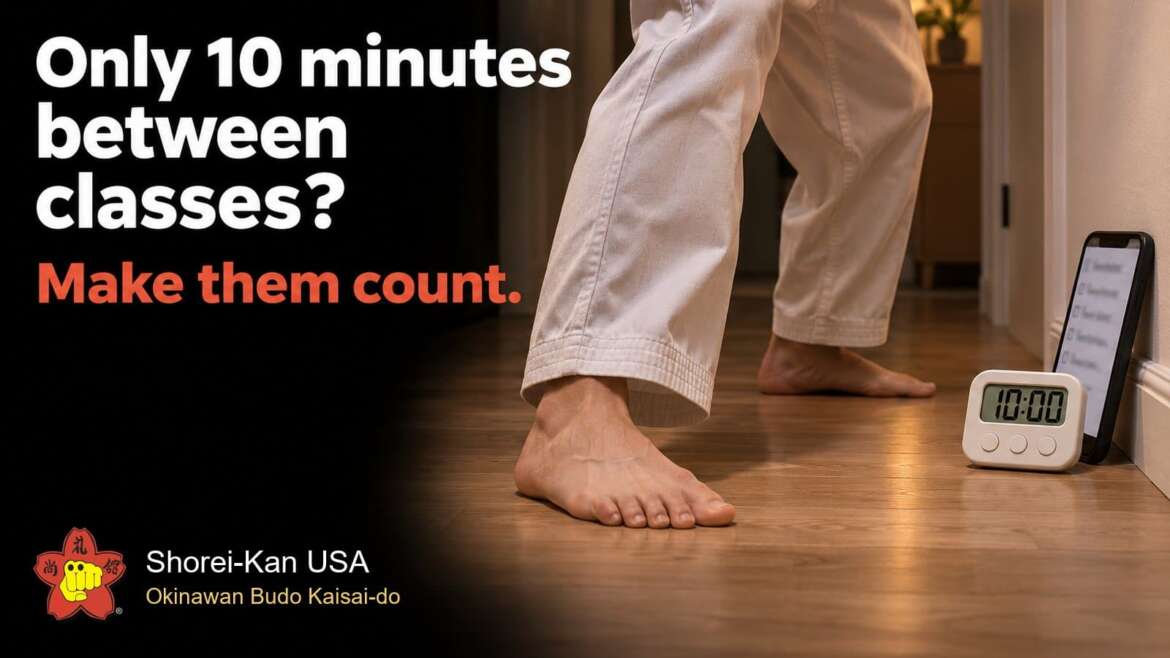
Good practice at home is short, focused, and built only on what your instructor has already taught you. Choose one thing from your last class, spend about ten minutes reviewing it slowly a few days a week, and write down what you want to ask at your next class. Home practice is for reinforcing class, not for learning new techniques on your own.
Most adult students have limited time between classes. Work, family, and everything else leave little room for a long training session. The good news is that you do not need one. A small amount of well-planned practice does more than an occasional long session, and it keeps you from building habits your instructor will have to undo.
The One Rule for Home Practice
The Rule
Review what you were taught. Do not teach yourself what you were not.
New material belongs in class, where an instructor can see it and correct it.
There is a practical reason for this. Without someone watching, it is easy to repeat a small mistake until it feels natural. Techniques learned from videos or other sources may also be taught differently from the way your school teaches them. Both can slow you down when you return to class.
Step 1: Capture Your Practice Plan Right After Class
The best time to plan your practice is in the few minutes after class, while it is still fresh. Keep it short. A note on your phone is enough.
After-Class Practice Card
What we worked on
Example: first section of my kata
My correction
Example: keep my back heel down
My one focus this week
Example: stance on the turns
Question for next class
Example: which hand leads on the second turn?
If you are not sure what to focus on, ask the instructor before you leave: "What is the one thing I should review this week?" That single question can shape your whole week of practice.
Step 2: Choose One Focus
Trying to review everything at once usually means reviewing nothing well. Pick one focus for the week:
- A section of a kata you are learning
- A stance the instructor corrected
- A transition, such as a turn, that keeps tripping you up
- The order of movements you keep forgetting
One focus, practiced a few times across the week, will usually show up in class as real improvement.
Step 3: Use a Simple 10-Minute Session
You do not need a long session. Ten minutes of focused review is enough to make a difference. Here is one way to structure it:
2 MIN
Loosen up
Light movement to warm up. Nothing strenuous.
5 MIN
Your one focus
Slowly, with attention on the correction you wrote down.
2 MIN
Run it through
Put the section back into the material around it.
1 MIN
Note it
What felt better? What to ask?
Go slowly. At home, the goal is accuracy, not speed or power. Moving slowly lets you notice where your feet are, which way you are facing, and whether you are applying the correction.
Step 4: Spread It Across the Week
Several short sessions spread across the week tend to help you remember more than one long session. Research on motor learning has found that practice spaced across days leads to better retention than the same amount of practice crammed together (Shea et al., 2000).
CLASS DAY
Learn, then fill in your practice card
NEXT DAY
10 minutes on your one focus
A DAY OFF
Rest, or a few minutes of mental review
MIDWEEK
10 minutes on your one focus
DAY BEFORE CLASS
A slow run-through and your question ready
Adjust this to your schedule. Two or three short sessions in a week are a solid start. If you train only once a week, these sessions matter even more. For more on that, read Can I Make Progress in Martial Arts if I Can Only Attend Once a Week?
When You Cannot Move: Mental Practice
Some days you will not have the time or space to practice physically. Mental practice, walking through the movements in your mind, can still help.
A widely cited review of research on mental practice published in the Journal of Applied Psychology (Driskell, Copper, and Moran, 1994) found that mentally rehearsing a task improved performance compared with no practice, though less than physical practice. It was especially useful for tasks with a strong thinking component, like remembering the order of a sequence. The benefit also faded after a couple of weeks without further practice, which is another reason to keep it regular.
To try it, sit quietly and picture yourself performing your focus section from start to finish. Notice each step, each turn, and each stance. A few minutes is enough.
What Not to Practice Alone
Some things are better left for class, where you have an instructor and a trained partner.
Good for home
- ✓ Kata sections you have been taught
- ✓ Stances and footwork, done slowly
- ✓ A specific correction from class
- ✓ Terminology and the order of movements
- ✓ Mental walk-throughs
Better left for class
- ✗ New kata sections you have not been shown
- ✗ Techniques learned from videos
- ✗ Partner applications with untrained family or friends
- ✗ Full-power striking without guidance
- ✗ Anything that causes pain
Setting Up a Small Practice Space
You do not need much room. A clear area a few steps wide is enough for most kata sections if you practice them in parts.
- Clear anything you could trip over or hit.
- Choose a floor that is not slippery.
- Practice slowly enough to stay in control.
- Stop if something hurts, and mention it to your instructor.
If a kata needs more room than you have, practice the section that fits, or walk through the rest mentally.
Bring It Back to Class
Home practice works best when it connects to class. When you return:
At Your Next Class
- Ask the question on your practice card.
- Ask whether your focus area looks better.
- Ask what to focus on next.
- Ask whether anything you practiced at home needs adjusting.
This loop of class, short practice, and feedback is how home practice turns into steady progress. If you keep losing the thread of a kata, read I Keep Forgetting Martial Arts Movements: Does That Mean I'm Not Making Progress? Parents helping a child at home may find How to Support Martial Arts Practice Without Becoming Your Child's Second Instructor more useful.
Training at Shorei-Kan USA
Shorei-Kan USA's Adult program follows a systematic, progressive approach to Okinawan Budo Kaisai-do. Students build a foundation through individual techniques, kata, prearranged sequences, partner practice, and practical applications before moving toward more advanced material under instructor direction. Complete beginners are welcome, and seniors train in the regular Adult classes.
Kata is central to that curriculum, and it is well suited to short home review because it can be practiced alone. The partner side of training, including bunkai and kiso kumite, belongs in class with a trained partner. Classes also include Daruma Taiso, a series of exercises and stretches used in Shorei-Kan training. Ask the instructor whether any of these are suitable for you to practice at home. For more on how kata and partner work fit together, read Why Practice Kata?
Classes at the Cortlandt Manor headquarters are led by Shihan Scott Lenzi, who began training in 1972 and holds the rank of 8th Dan in Budo Kaisai-do and 7th Dan in Okinawan Kobudo.
Adult Classes at a Glance
Training
Techniques, kata, prearranged sequences, partner practice, applications, and Daruma Taiso
Who trains
Complete beginners, experienced students, and seniors in the regular Adult classes
Where
Cortlandt Manor headquarters, 1062 Oregon Road. See the class schedule.
New students
Ask about current offers when you call
Frequently Asked Questions
How often should I practice martial arts at home?
Two or three short sessions a week is a good start for most adult beginners. Spreading practice across several days tends to help you remember more than one long session.
How long should a practice session at home be?
About ten minutes is enough when it is focused. Spend most of that time slowly reviewing one thing your instructor taught or corrected.
Can I learn martial arts from videos?
Videos may teach techniques differently from your school, and no one is there to correct you. Use class to learn new material, and use home practice to review what you were taught.
Does visualizing movements help?
Research on mental practice suggests it can help, especially for remembering sequences, though physical practice helps more. A few minutes of mental review is useful on days you cannot practice physically.
What if I do not have much space at home?
Practice the parts of a kata that fit your space, and walk through the rest mentally. A small, clear area with a non-slippery floor is enough for most review.
Train in Cortlandt Manor
Short practice between classes works best when it builds on good instruction.
Ask about current new-student offers when you call, or see the special offers page.
Call Shorei-Kan USA at 914-739-7804 or use the contact page to ask about the Adult class and current class times.
Practice With Purpose
Ready to Train With Guidance?
The best home practice builds on what you learn in class. Contact the Cortlandt Manor dojo to ask about current Adult class times.
PLAN YOUR VISIT CALL 914-739-7804
1062 Oregon Road, Cortlandt Manor, NY 10567