
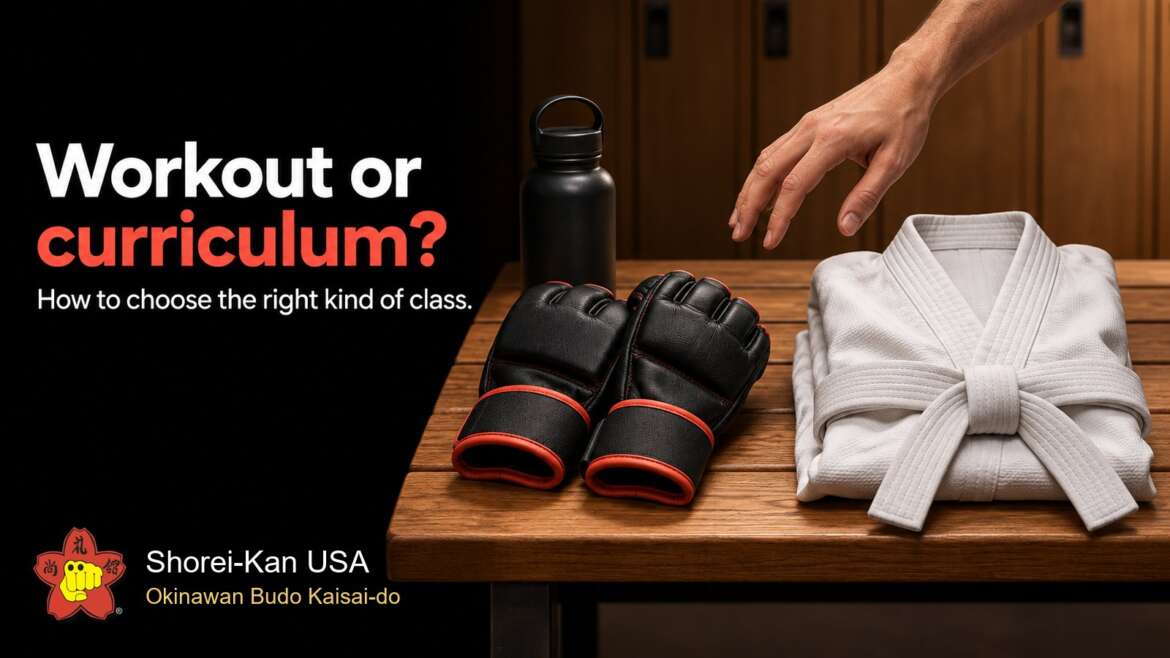
Choose fitness kickboxing if your main goal is a high-energy workout you can drop into when it fits your schedule. Choose traditional martial arts if you want a curriculum: skills that build on each other, technical feedback, partner practice, and a long-term path of progress, with a real workout included. Neither is better. They are built for different purposes, and the right choice depends on what you want to get out of each hour.
Many adults start looking at martial arts for exercise, then find themselves comparing two very different kinds of classes. Both involve punches and kicks, and both will make you sweat. The difference is in what the class is designed to do.
First, Three Terms That Get Mixed Up
"Kickboxing" can mean very different things depending on the gym. Before comparing, it helps to know which one you are looking at.
EXERCISE CLASS
Fitness kickboxing
Also called cardio kickboxing. A workout built from punches and kicks, often on bags or pads, usually without sparring or rank.
COMBAT SPORT
Kickboxing
A striking sport with sparring and, for some, competition. Training focuses on fighting under sport rules.
MARTIAL ART
Traditional martial arts
A structured system of technique, forms, partner work, and etiquette, with progression through ranks over years.
This article compares the first and the third: a fitness class and a traditional martial art. Individual gyms and dojos vary, so treat the comparison as a general guide.
Side by Side
FITNESS KICKBOXING
TRADITIONAL MARTIAL ARTS
Main purpose
FITNESS KICKBOXING
A workout
MARTIAL ARTS
A skill and a system to learn
Typical class
FITNESS KICKBOXING
Warm-up, punch and kick combinations, conditioning, often to music
MARTIAL ARTS
Basics, kata, partner exercises, and conditioning
Technical feedback
FITNESS KICKBOXING
Varies. Large classes may offer limited correction
MARTIAL ARTS
Regular correction from an instructor
Progression
FITNESS KICKBOXING
Each class usually stands on its own
MARTIAL ARTS
Skills build on each other, with ranks along the way
Partner contact
FITNESS KICKBOXING
Usually none, or pad work only
MARTIAL ARTS
Partner exercises introduced gradually, with sparring later
Schedule
FITNESS KICKBOXING
Often flexible and drop-in friendly
MARTIAL ARTS
Regular attendance helps you keep up with the curriculum
What you leave with
FITNESS KICKBOXING
A good sweat and better fitness
MARTIAL ARTS
Fitness, plus technique, forms, and knowledge that keep growing
Workout or Curriculum? Check What Matters to You
Workout-first
- ☐ I mainly want to burn energy and sweat
- ☐ I want to drop in when my schedule allows
- ☐ I like music and a fast pace
- ☐ I do not want partner contact
- ☐ I am not looking for ranks or a long-term path
Curriculum-first
- ☐ I want to learn a skill that keeps building
- ☐ I want an instructor to correct my technique
- ☐ I am interested in forms, applications, and tradition
- ☐ I want goals and a clear path of progress
- ☐ I am open to working with a partner
If most of your checks landed on one side, that is a strong hint. If they are split, you may enjoy either, or both.
Do Martial Arts Count as Exercise?
Yes. Many people assume martial arts training is mostly technique and tradition, but it can be real physical work. The Compendium of Physical Activities, a research reference used to estimate the energy cost of activities, lists intensity values called METs. One MET is roughly the energy you use sitting at rest. Activities from 3 to 6 METs are generally considered moderate, and above 6 is vigorous.
Estimated Intensity (METs)
Source: 2024 Adult Compendium of Physical Activities
Martial arts, slower pace, novice practice
Kickboxing
Martial arts, different types, moderate pace
Scale runs from 0 to 12 METs. Moderate begins at 3 and vigorous at 6. These are population estimates. Actual intensity depends on the class, the pace, and your own effort.
In the Compendium, martial arts of different types at a moderate pace fall well into the vigorous range. Slower-paced novice practice is still moderate. For comparison, the CDC recommends that adults get at least 150 minutes of moderate-intensity or 75 minutes of vigorous-intensity aerobic activity each week, plus muscle-strengthening activity on two or more days.
The practical takeaway: both a fitness kickboxing class and a martial arts class can count toward your weekly activity. How much depends on the class and how hard you work, not on the label.
The Differences That Do Not Show Up on a Calorie Count
If both can be a good workout, the choice comes down to what else you want from the hour.
Feedback
In a curriculum-based class, an instructor corrects your technique so it improves over time.
Mental work
Learning sequences, applications, and terminology keeps your mind engaged along with your body.
Continuity
Each class builds on the last, which gives you a reason to come back beyond the workout itself.
Flexibility
A drop-in fitness class can be easier to fit around an unpredictable week.
Think about what has kept you exercising in the past. If variety and energy keep you going, a fitness class may suit you. If learning and measurable progress keep you going, a curriculum may be what you have been missing.
Questions to Ask Before You Choose
Whichever type of class you visit, these questions help you compare:
Ask Any Class
- What is the main goal of this class?
- Will someone correct my technique, and how often?
- Is there a progression, or is each class similar?
- Is there partner work or sparring?
- How is the class adjusted for beginners or limitations?
- Can I try a class before committing?
Can You Do Both?
Yes. Some people use a fitness class for extra conditioning and a martial arts class for skill. If you try that, keep an eye on recovery, and let your instructor know about any other training you are doing. For a realistic look at fitting training into a busy week, read Can I Make Progress in Martial Arts if I Can Only Attend Once a Week?
If you are comparing Okinawan Budo Kaisai-do with another martial art rather than a fitness class, read Traditional Martial Arts or Brazilian Jiu-Jitsu: Which Kind of Class Do You Want?
Okinawan Budo Kaisai-do at Shorei-Kan USA
Shorei-Kan USA teaches Okinawan Budo Kaisai-do, the evolution of Okinawan Goju-Ryu, not fitness kickboxing. The school describes Okinawan Budo Kaisai-do as being "for people who wish to learn self-defense techniques and to improve physical and mental conditions," and says its curriculum allows older people "to pursue physical conditioning and the mastering of techniques."
The Adult program follows a systematic, progressive approach to Okinawan Budo Kaisai-do. Training includes individual techniques, kata, prearranged sequences, partner practice, and practical applications. Classes also include Daruma Taiso, a series of exercises and stretches used in Shorei-Kan training. Complete beginners are welcome, and seniors train in the regular Adult classes.
Classes at the Cortlandt Manor headquarters are led by Shihan Scott Lenzi, who began training in 1972 and holds the rank of 8th Dan in Budo Kaisai-do and 7th Dan in Okinawan Kobudo.
Adult Classes at a Glance
Type of class
Okinawan Budo Kaisai-do curriculum with progressive ranks
Training
Techniques, kata, partner practice, applications, and Daruma Taiso exercises and stretches
Who trains
Complete beginners, experienced students, and seniors in the regular Adult classes
Where
1062 Oregon Road, Cortlandt Manor. See the class schedule.
New students
Ask about current offers when you call
If you are starting later in life, read Starting Martial Arts After 40: How to Set Goals Without Comparing Yourself to Others. If you have never been to a martial arts class, read What to Expect at Your First Martial Arts Class as an Adult.
Frequently Asked Questions
Is martial arts training a good workout?
It can be. The Compendium of Physical Activities rates martial arts of different types at a moderate pace in the vigorous-intensity range, and slower novice practice as moderate. Actual intensity depends on the class and your effort.
Which burns more calories, traditional martial arts or fitness kickboxing?
It depends on the class, the pace, and the person. Both can reach moderate to vigorous intensity. If calories are your main goal, choose the class you will attend consistently and work hard in.
Is fitness kickboxing a martial art?
Fitness kickboxing uses techniques from martial arts but is designed as an exercise class. It usually does not include sparring, forms, or a rank system. Kickboxing as a combat sport is different and does include sparring.
Can I do martial arts just for fitness?
Yes. Some adults start martial arts partly for exercise. You will also be learning a curriculum, so expect technical instruction and a structured progression along with the workout.
Can I do both martial arts and a fitness class?
Yes. Some people combine the two. Watch your recovery and let your instructor know about other training you are doing.
Try a Martial Arts Class in Cortlandt Manor
The best way to know whether a curriculum suits you is to try a class and see how it feels.
Ask about current new-student offers when you call, or see the special offers page.
Call Shorei-Kan USA at 914-739-7804 or use the contact page to ask about the Adult class and current class times.
Learn While You Train
Ready to Try a Martial Arts Class?
Get a real workout while learning a traditional martial art. Contact the Cortlandt Manor dojo to ask about current Adult class times.
PLAN YOUR VISIT CALL 914-739-7804
1062 Oregon Road, Cortlandt Manor, NY 10567