
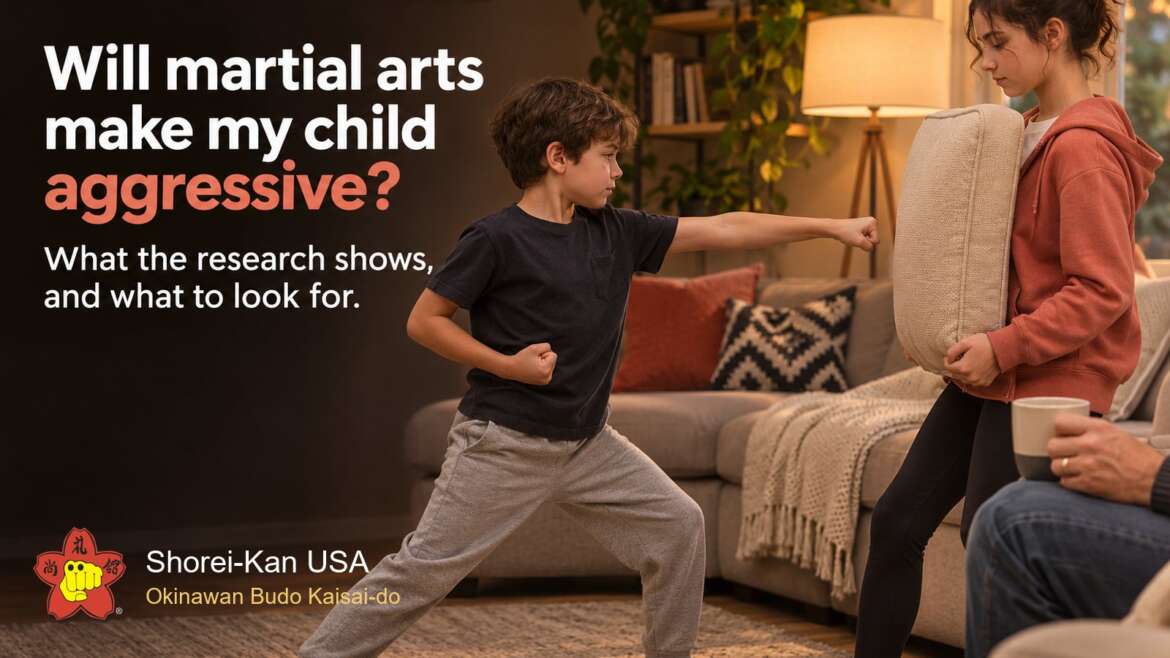
For most children, well-taught martial arts does not make them more aggressive. Research on structured youth programs points the other way: training is linked with less aggressive behavior and more prosocial behavior, such as cooperation and helping others. The research is promising rather than final, and how a class is taught matters a great deal. Here is what the studies say, what to look for in a class, and what to watch at home.
It is a fair question. Martial arts involves kicks, punches, and partner drills, and some parents worry that teaching a child to strike will make them more likely to use it. Other parents have the opposite hope: that a child who is already quick to anger will learn to calm down. Both deserve a straight answer.
The Short Answer
What the evidence suggests
- Structured programs are linked with less aggression
- Children also tend to show more prosocial behavior
- Self-control and respect are part of what is taught
What it does not prove
- That every class or school has the same effect
- That training will change a particular child
- That martial arts can replace professional help
What the Research Says
Researchers have studied this question for decades. Two reviews that combine the results of many studies are especially useful.
A 2017 META-ANALYSIS
Researchers pooled studies of martial arts programs for children and youth and found that training was associated with a reduction in aggressive behavior. (Harwood, Lavidor, and Rassovsky, Aggression and Violent Behavior, 2017)
A 2025 REVIEW OF 16 TRIALS
A systematic review and meta-analysis of 16 randomized controlled trials found that martial arts programs increased children's prosocial behavior and reduced aggressive behavior. (Adolescent Research Review, 2025)
That is encouraging, but it is worth reading carefully. Many of the studies were small, programs varied, and most followed children for weeks or months rather than years. The fairest summary is that well-run martial arts programs appear to help, and there is little evidence that they make children more aggressive. They are not a guaranteed fix.
Why the Teaching Matters More Than the Kicks
Learning a technique is not the same as learning to use it on someone. In a well-run class, every technique comes with rules about when it is allowed, how much force to use, and how to look after a partner. Children practice stopping, not just striking.
What a Good Class Teaches Alongside Technique
- ✓ Control: moving with care, especially around a partner
- ✓ Listening: starting and stopping on the instructor's word
- ✓ Respect: bowing, courtesy, and taking turns
- ✓ Patience: repeating basics until they are right
- ✓ Purpose: technique is for defense, never for showing off or settling scores
The atmosphere matters too. A class that runs on yelling, shaming, or "toughening kids up" sends a different message than one built on calm, clear correction. For what respectful teaching looks like, read Martial Arts Discipline Without Humiliation: What Parents Can Look For.
Signs a Class Is Building Self-Control
When you visit or watch a class, these are good signs:
Good Signs to Look For
- ☐ The instructor talks about when not to use what students learn
- ☐ Partner drills are slow, controlled, and closely supervised
- ☐ Rough play or showing off is corrected right away, calmly
- ☐ Children who hold back or feel nervous are not singled out
- ☐ Courtesy is expected from everyone, including the instructors
Be cautious if a school encourages children to "fight back" at school, celebrates hard contact between young children, or treats aggression as toughness. For more on choosing a school, read How to Choose a Martial Arts School in Cortlandt Manor.
What If My Child Already Struggles With Anger?
Some parents consider martial arts precisely because their child gets angry easily or acts out physically. A structured class can give a child clear rules, a physical outlet, and steady practice in self-control, and the research above is hopeful on that front.
Still, martial arts is an activity, not a treatment. If your child's anger is frequent, intense, or causing problems at school or at home, talk with your pediatrician, school counselor, or a mental health professional first. Training can be a good addition to that support, not a replacement for it.
It also helps to tell the instructor what you have noticed, privately, before your child starts. A good instructor will want to know and will tell you honestly whether the class is a fit right now. If you are unsure whether your child is ready for a structured class at all, read Is My Child Ready for Structured Martial Arts Classes?
What to Watch at Home
Children who are excited about a new activity often want to show it off. Trying a move on a sibling once is usually enthusiasm, not a warning sign. What matters is how it is handled.
Usually normal
- ✓ Practicing kicks and stances around the house
- ✓ Wanting to show you what they learned
- ✓ Playful moves that stop when asked
Worth a conversation
- ✗ Using techniques to hurt or scare someone
- ✗ Not stopping when another child says stop
- ✗ Physical conflicts at school that are new or increasing
If you see the second list, talk with your child and let the instructor know. Most schools have clear expectations about using training outside class, and hearing it from the instructor often carries weight. A simple family rule also helps: we only practice with a partner in class, or when an adult says it is okay.
If your child has been on the receiving end of rough treatment from other children, that is a different situation. Read My Child Is Being Bullied: What Can Martial Arts Offer, and What Else Needs Attention?
Shorei-Kan USA's Approach
Shorei-Kan describes Okinawan Budo Kaisai-do as a Budo, which it translates as "the way to stop fighting." The school presents martial arts as a way to train the mind and body while learning technique for defense rather than aggression.
That philosophy is reflected in the school's Dojo Kun, its guiding principles, which include "Always be courteous and humble," "Cultivate a peaceful spirit," and "Learn to be patient."
The Junior program introduces younger students to the fundamentals of Okinawan Budo Kaisai-do with age-appropriate pacing and close instructor supervision. The school describes the approach as structured and nonaggressive, with an emphasis on careful practice, courtesy, patience, and the use of technique for defense.
Classes at the Cortlandt Manor headquarters are led by Shihan Scott Lenzi, who began training in 1972 and holds the rank of 8th Dan in Budo Kaisai-do and 7th Dan in Okinawan Kobudo.
Junior Classes at a Glance
Philosophy
Budo, "the way to stop fighting," with technique taught for defense
Approach
Age-appropriate pacing, close supervision, structured and nonaggressive
Cortlandt Manor
Headquarters, 1062 Oregon Road. See the class schedule for Junior times.
Greenwood Lake
Junior Class, Tuesdays, 5:00 to 5:30 p.m.
Frequently Asked Questions
Will martial arts make my child more aggressive?
For most children, well-taught martial arts is not linked with more aggression. Reviews of structured youth programs have found reduced aggressive behavior and increased prosocial behavior. Results depend on how the class is taught, so look for a school that emphasizes control and respect.
Can martial arts help a child who gets angry easily?
It may help as part of a broader plan. Structured classes offer clear rules, a physical outlet, and practice in self-control. If anger is frequent or intense, talk with your pediatrician or school counselor first, and tell the instructor what you have noticed.
My child tried a move on a sibling. Should I worry?
Usually not. Excited children often show off what they learn. Set a simple rule that partner practice happens only in class or with an adult's okay, and let the instructor know if it keeps happening or someone gets hurt.
How can I tell if a class teaches self-control?
Watch a class. Look for slow, supervised partner work, an instructor who talks about when not to use techniques, calm correction of rough play, and courtesy from everyone. Be cautious of schools that encourage children to fight back or treat aggression as toughness.
Is the research on martial arts and aggression settled?
Not completely. Meta-analyses have found a promising link between structured martial arts programs and reduced aggression, but many studies were small and short. The evidence supports martial arts as a healthy option, not a guaranteed result.
Talk With the Dojo in Cortlandt Manor
If you are wondering whether martial arts would be a good fit for your child, the best next step is to talk with the instructor and watch a class.
Ask about current new-student offers when you call, or see the special offers page.
Call Shorei-Kan USA at 914-739-7804 or use the contact page to talk about Junior classes.
The Way to Stop Fighting
See How Self-Control Is Taught
Start with a conversation. Contact the Cortlandt Manor dojo to talk about your child, the Junior program, and watching a class.
CONTACT THE DOJO CALL 914-739-7804
1062 Oregon Road, Cortlandt Manor, NY 10567